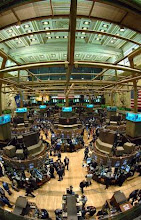
Europe's leading exchanges made strong advances in midday deals as the Dow is set to rise in opening deals, and boosted by some upbeat earnings statements and M&A news.
At 12.09 a.m., the DJ STOXX 50 was up 50.99 points, or 1.81 percent, at 2,874.93 and the DJ STOXX 600 was up 5.22 points, or 1.88 percent, at 282.81.
Spread bettors IG Index said the DJIA looks set to rise 87 points in opening deals as falling oil prices help to allay concerns about inflation and the health of the world's largest economy.
As for Tuesday's Federal Reserve rate setting meeting, he said no change to rates is expected but the accompanying commentary will be a focus.
In Europe, Societe Generale (Paris: FR0000130809 - news) reported a 63 percent fall in second-quarter net profit on Tuesday to 644 million euros -- but well above the 518 million euros the market had been looking for.
Gross operating profit fell 42 percent to 1.627 billion euros, also ahead of an average forecast of 1.333 billion. Shares added 6.67 percent as analysts described the update as 'reassuring'. Credit Agricole (Paris: FR0000045072 - news) added 4.6 percent as analysts said the report was good news for SocGen's peers.
Standard Chartered (LSE: STAN.L - news) added 4.64 percent after the group's first-half results beat analysts' forecasts.
Barclays (LSE: BARC.L - news) stormed 7.22 percent higher after news that Swiss Re (Virt-X: RUKN.VX - news) agreed to buy the UK bank's life assurance arm for 753 million pounds to boost its Admin Re business in the United Kingdom.
And shares in the Swiss insurance group moved up 1.76 percent after it reported better than expected second-quarter numbers.
Shares in Franco-Dutch airline Air France (Paris: FR0000031122 - news) -KLM rose 7.01 percent after the airline operator announced a smaller than expected fall in net profit for its first quarter to June and maintained its full-year EBIT guidance at 1 billion euros.
Sales were slightly above forecasts and net profit was above consensus though in line with Cheuvreux's estimate, the French broker's analysts said in a note to clients.
Adidas (Xetra: 500340 - news) hiked its guidance for full-year gross margin -- a measure of profitability -- to more than 48 percent, compared with a previous forecast between 47.5 percent as the group reported better than expected second-quarter net profit. Shares added 7.3 percent.
Danish brewer Carlsberg (Copenhagen: CARLB.CO - news) climbed 13.95 percent amid widespread relief after it reported a better than expected set of second-quarter earnings. Lehman Brothers (NYSE: LEH - news) resumed coverage with an 'overweight' stance.
Diageo (LSE: DGE.L - news) added 2.45 percent after reports that Inbev (Brussels: INB.BR - news) could be interested in buying the group, although not immediately.
In other M&A news, Michael Page (LSE: MPI.L - news) climbed 33.08 percent as the group confirmed it has received an unsolicited approach from Adecco (Virt-X: ADEN.VX - news) , up 5.42 percent.
The Independent said on Tuesday morning (NASDAQ: TUES - news) the Swiss staffing group is preparing a bid of between 350-375 pence per share but the UK group said the offer was unsolicited.
Peers USG People, Hays (LSE: HAS.L - news) and Brunel added 6.03 percent, 15.03 percent and 4.03 percent respectively as some said Michael Page's apparent hostility to its suitor's approach opens up the possibility that Adecco will be forced to shift its affections elsewhere.
Oils fell as the price of crude dropped to a three-month low and back below $120 per barrel, as investors focused on rising OPEC supply and declining demand in the United States and Europe.
Future dated crude on the Nymex was $1.80 lower at $119.61 per barrel, well below the July 11 record high of $147.27 per barrel.
Total fell 1.75 percent, ENI (Milan: ENI.MI - news) was 0.86 percent lower and Repsol (Madrid: REP.MC - news) was down 0.25 percent.

German shares close higher, boosted by lower oil prices, UPDATE
German shares were higher at the close with dealers saying local indices were benefiting from continuing easing oil prices and gains in the early Wall Street trading session.
Adidas (Xetra: 500340 - news) raced ahead atop a large group of gainers after the sportswear maker released solid quarterly figures.
The DAX was up 168.89 points or 2.66 percent to 6,518.70 at the close, having traded between 6,342.93 and 6,532.09.
The MDAX added 80.02 points or 0.99 percent to 8,129.78, while the TecDAX (Xetra: news) rose 13.95 points or 1.87 percent to 761.78.
DAX (Xetra: news) futures added 170.00 points or 2.66 percent to 6,561.00, while bund futures gained 0.32 points or 0.28 percent to 112.94. The euro traded at $1.5464, compared with $1.5489 in afternoon deals.
Traders pointed to lower oil prices helping automakers and export-intensive stocks.
Oil prices kept falling on Tuesday, sinking as low as $118 a barrel on growing concerns that a U.S. economic slowdown and high energy costs are curbing consumer demand for fuel, one day after plunging as much as $5 a barrel.
'You could already see oil prices falling overnight, but it appears as if the market was a bit slow to react and we are now seeing the DAX recover due to the lower prices,' said a Frankfurt-based trader.
Wall Street shares opened higher, but investors will be casting an eye on the U.S. Federal Reserve rate decision later today. The lending body is expected to keep its benchmark federal funds rate steady at 2 percent.
Leading blue chips higher, Adidas surged 2.94 euros or 7.66 percent to 41.31 as local dealers said the sports equipment manufacturer released strong second-quarter figures, reiterated key top- and bottom-line and slightly increased its gross margin and EBIT margin guidance.
Infineon (Xetra: 623100 - news) was 0.345 euros or 6.87 percent higher at 5.365, after Deutsche Bank (Frankfurt: DB9999 - news) initiated coverage with a 'buy' rating and 7.0 euros per share target, saying the chipmaker's currently depressed profitability should recover thanks to a restructuring program and an organic wireless profitability turnaround.
Lufthansa (Xetra: 823212 - news) shares gained 0.93 euros or 6.40 percent to 15.47, helped by lower oil prices and after the airline said on Monday it will seek damages from pilot union Cockpit should the pilots go ahead with plans to stage a strike this week.
Deutsche Bank was 3.36 euros or 5.81 percent stronger at 61.19 at the top of a group of financial titles, which were in demand today.
Allianz rose 5.33 euros or 4.90 percent to 114.05 after a newswire report said that China Development Bank (CDB) could make a bid for the financial services company's Dresdner Bank unit, though traders and analysts expressed skepticism.
At the other end of the DAX, E.ON slipped 1.15 euros or 0.94 percent to 121.30 and Thyssenkrupp (Xetra: 750000 - news) lost 0.03 euros or 0.09 percent to 34.67, as the session's only two decliners.
Over on the MDAX (Xetra: news) , Pfleiderer (Xetra: 676474 - news) rose 1.04 euros or 12.94 percent to 9.08.
MTU Aero Engines (Xetra: A0D9PT - news) was 1.87 euros or 9.81 percent higher at 20.94, which traders attributed to oil prices declines.
Heidelberger Druckmaschinen (Xetra: 731400 - news) was 0.25 euros or 2.17 percent higher at 11.75 after the printing specialist said its second-quarter operating profit rose to 698 million euros from last year's 506 million euros, due to a strong performance in most regions and despite higher raw material costs.
At the other end of the index, K+S (Xetra: 716200 - news) retreated 4.57 euros or 6.32 percent to 67.78, as the index's worst performer.
Beiersdorf (Xetra: 520000 - news) was 1.64 euros or 3.98 percent lower at 39.54, after the cosmetics specialist released second-quarter figures that disappointed across the board, especially with weak growth and gross margins.
Over on the TecDAX, Qiagen (NASDAQ: QGEN - news) was 0.87 euros or 7.29 percent stronger at 12.81, helped by consensus-beating quarterly figures.
Freenet (Xetra: A0EAMM - news) was the worst performer among tech stocks, down 0.59 euros or 5.10 percent at 10.97, after its second-quarter figures disappointed.
Adidas (Xetra: 500340 - news) raced ahead atop a large group of gainers after the sportswear maker released solid quarterly figures.
The DAX was up 168.89 points or 2.66 percent to 6,518.70 at the close, having traded between 6,342.93 and 6,532.09.
The MDAX added 80.02 points or 0.99 percent to 8,129.78, while the TecDAX (Xetra: news) rose 13.95 points or 1.87 percent to 761.78.
DAX (Xetra: news) futures added 170.00 points or 2.66 percent to 6,561.00, while bund futures gained 0.32 points or 0.28 percent to 112.94. The euro traded at $1.5464, compared with $1.5489 in afternoon deals.
Traders pointed to lower oil prices helping automakers and export-intensive stocks.
Oil prices kept falling on Tuesday, sinking as low as $118 a barrel on growing concerns that a U.S. economic slowdown and high energy costs are curbing consumer demand for fuel, one day after plunging as much as $5 a barrel.
'You could already see oil prices falling overnight, but it appears as if the market was a bit slow to react and we are now seeing the DAX recover due to the lower prices,' said a Frankfurt-based trader.
Wall Street shares opened higher, but investors will be casting an eye on the U.S. Federal Reserve rate decision later today. The lending body is expected to keep its benchmark federal funds rate steady at 2 percent.
Leading blue chips higher, Adidas surged 2.94 euros or 7.66 percent to 41.31 as local dealers said the sports equipment manufacturer released strong second-quarter figures, reiterated key top- and bottom-line and slightly increased its gross margin and EBIT margin guidance.
Infineon (Xetra: 623100 - news) was 0.345 euros or 6.87 percent higher at 5.365, after Deutsche Bank (Frankfurt: DB9999 - news) initiated coverage with a 'buy' rating and 7.0 euros per share target, saying the chipmaker's currently depressed profitability should recover thanks to a restructuring program and an organic wireless profitability turnaround.
Lufthansa (Xetra: 823212 - news) shares gained 0.93 euros or 6.40 percent to 15.47, helped by lower oil prices and after the airline said on Monday it will seek damages from pilot union Cockpit should the pilots go ahead with plans to stage a strike this week.
Deutsche Bank was 3.36 euros or 5.81 percent stronger at 61.19 at the top of a group of financial titles, which were in demand today.
Allianz rose 5.33 euros or 4.90 percent to 114.05 after a newswire report said that China Development Bank (CDB) could make a bid for the financial services company's Dresdner Bank unit, though traders and analysts expressed skepticism.
At the other end of the DAX, E.ON slipped 1.15 euros or 0.94 percent to 121.30 and Thyssenkrupp (Xetra: 750000 - news) lost 0.03 euros or 0.09 percent to 34.67, as the session's only two decliners.
Over on the MDAX (Xetra: news) , Pfleiderer (Xetra: 676474 - news) rose 1.04 euros or 12.94 percent to 9.08.
MTU Aero Engines (Xetra: A0D9PT - news) was 1.87 euros or 9.81 percent higher at 20.94, which traders attributed to oil prices declines.
Heidelberger Druckmaschinen (Xetra: 731400 - news) was 0.25 euros or 2.17 percent higher at 11.75 after the printing specialist said its second-quarter operating profit rose to 698 million euros from last year's 506 million euros, due to a strong performance in most regions and despite higher raw material costs.
At the other end of the index, K+S (Xetra: 716200 - news) retreated 4.57 euros or 6.32 percent to 67.78, as the index's worst performer.
Beiersdorf (Xetra: 520000 - news) was 1.64 euros or 3.98 percent lower at 39.54, after the cosmetics specialist released second-quarter figures that disappointed across the board, especially with weak growth and gross margins.
Over on the TecDAX, Qiagen (NASDAQ: QGEN - news) was 0.87 euros or 7.29 percent stronger at 12.81, helped by consensus-beating quarterly figures.
Freenet (Xetra: A0EAMM - news) was the worst performer among tech stocks, down 0.59 euros or 5.10 percent at 10.97, after its second-quarter figures disappointed.
Milan shares close higher; Seat PG, Pirelli among leaders UPDATE
Share prices closed higher, tracking the international trend on the recent lower oil price, with leaders including Seat PG on company comments on cutting its debt, and Pirelli (Milan: PC.MI - news) up on its firm second-half outlook, brokers said.
The Mibtel index rose 2.72 percent to 21,955 points and the S&P/Mib was up 3.33 percent to 28,753.
Volume traded was an estimated 3.680 billion euros.
Brokers said the lower oil price is prompting a switch by investors into bank stocks, out of oil stocks, reversing a major trend seen in the last year because of the credit market crisis.
One broker said it is unclear how far the oil price will fall, adding that $115 a barrel could prove a resistance to further falls with the price even rebounding upwards again.
Seat PG rose 6.86 percent to 0.081 euros. Brokers said the stock was extending Monday's gains on weekend comments by CEO Luca Majocchi that the company will meet full-year targets and is mulling asset sales.
Brokers said the market is appreciating Seat PG's early redemption of debt, which is a worry, while competing with Google (NASDAQ: GOOG - news) on local advertising is less of a factor in the upcoming business plan.
Mondadori (Milan: MN.MI - news) gained 5.48 percent to 3.9975. L'Espresso rose 1.43 percent to 1.635.
Other gainers included Italcementi (Milan: IT.MI - news) , up 7.65 percent to 9.005, bouncing after recent weakness on its poor results last week. Buzzi Unicem (Milan: BZU.MI - news) added 5.98 percent to 13.83.
Autogrill (Milan: AGL.MI - news) gained 8.69 percent to 8.32, accelerating late in the session.
Atlantia (Milan: ATL.MI - news) was up 0.44 percent to 17.08 ahead of Tuesday evening's results. One broker said smaller motorway peer SIAS (Milan: SIS.MI - news) announced on Tuesday 'decent' traffic trends, which should also be seen in Atlantia results.
SIAS added 1.19 percent to 7.21.
Pirelli was up 7.48 percent to 0.421 after the company announced results.
Brokers said the market reacted to Pirelli's second-half guidance, while first-half EBIT of 190.3 million euros was ahead of Deutsche Bank (Frankfurt: DB9999 - news) 's expectation for 177.3 million on this line.
One analyst said a write-down on Pirelli's remaining stake in Telecom Italia (Milan: TIT.MI - news) to 1.27 euros per share, the price at June 30, was already discounted by the market. Telecom Italia gained 4.06 percent to 1.154.
The Pirelli RE unit was up 10.20 percent to 14.65 after yesterday's results and conference call this morning.
Among other industrials, Fiat (Milan: F.MI - news) gained 5.06 percent to 10.96 and Prysmian lost 0.79 percent to 15.04.
Among luxury stocks, Luxottica (Milan: LUX.MI - news) gained 6.42 percent to 16.27. Brokers said the stock reacted to company statements on management remaining in place. Geox (Milan: GEO.MI - news) rose 3.63 percent to 7.28.
Banks were mostly on the positive side. Mediolanum (Milan: MED.MI - news) gained 6.34 percent to 2.87. Intesa Sanpaolo (Milan: ISP.MI - news) was up 6.01 percent to 3.83.
One broker said he was surprised that Intesa did not react more negatively to the Societe Generale (Paris: FR0000130809 - news) results, which he said showed weakness in retail banking. Overall, SocGen's results were in-line or above expectations.
Unicredit (Milan: UCG.MI - news) rose 5.87 percent to 3.9575, bouncing after weakness on last week's results.
Energies were lower. Saipem (Milan: SPM.MI - news) fell 1.71 percent to 23.01, Snam RG was down 1.85 percent to 4.135 and Tenaris (Milan: TEN.MI - news) lost 1.18 percent to 18.36. Eni (Milan: ENI.MI - news) eased 0.38 percent to 20.97.
The Mibtel index rose 2.72 percent to 21,955 points and the S&P/Mib was up 3.33 percent to 28,753.
Volume traded was an estimated 3.680 billion euros.
Brokers said the lower oil price is prompting a switch by investors into bank stocks, out of oil stocks, reversing a major trend seen in the last year because of the credit market crisis.
One broker said it is unclear how far the oil price will fall, adding that $115 a barrel could prove a resistance to further falls with the price even rebounding upwards again.
Seat PG rose 6.86 percent to 0.081 euros. Brokers said the stock was extending Monday's gains on weekend comments by CEO Luca Majocchi that the company will meet full-year targets and is mulling asset sales.
Brokers said the market is appreciating Seat PG's early redemption of debt, which is a worry, while competing with Google (NASDAQ: GOOG - news) on local advertising is less of a factor in the upcoming business plan.
Mondadori (Milan: MN.MI - news) gained 5.48 percent to 3.9975. L'Espresso rose 1.43 percent to 1.635.
Other gainers included Italcementi (Milan: IT.MI - news) , up 7.65 percent to 9.005, bouncing after recent weakness on its poor results last week. Buzzi Unicem (Milan: BZU.MI - news) added 5.98 percent to 13.83.
Autogrill (Milan: AGL.MI - news) gained 8.69 percent to 8.32, accelerating late in the session.
Atlantia (Milan: ATL.MI - news) was up 0.44 percent to 17.08 ahead of Tuesday evening's results. One broker said smaller motorway peer SIAS (Milan: SIS.MI - news) announced on Tuesday 'decent' traffic trends, which should also be seen in Atlantia results.
SIAS added 1.19 percent to 7.21.
Pirelli was up 7.48 percent to 0.421 after the company announced results.
Brokers said the market reacted to Pirelli's second-half guidance, while first-half EBIT of 190.3 million euros was ahead of Deutsche Bank (Frankfurt: DB9999 - news) 's expectation for 177.3 million on this line.
One analyst said a write-down on Pirelli's remaining stake in Telecom Italia (Milan: TIT.MI - news) to 1.27 euros per share, the price at June 30, was already discounted by the market. Telecom Italia gained 4.06 percent to 1.154.
The Pirelli RE unit was up 10.20 percent to 14.65 after yesterday's results and conference call this morning.
Among other industrials, Fiat (Milan: F.MI - news) gained 5.06 percent to 10.96 and Prysmian lost 0.79 percent to 15.04.
Among luxury stocks, Luxottica (Milan: LUX.MI - news) gained 6.42 percent to 16.27. Brokers said the stock reacted to company statements on management remaining in place. Geox (Milan: GEO.MI - news) rose 3.63 percent to 7.28.
Banks were mostly on the positive side. Mediolanum (Milan: MED.MI - news) gained 6.34 percent to 2.87. Intesa Sanpaolo (Milan: ISP.MI - news) was up 6.01 percent to 3.83.
One broker said he was surprised that Intesa did not react more negatively to the Societe Generale (Paris: FR0000130809 - news) results, which he said showed weakness in retail banking. Overall, SocGen's results were in-line or above expectations.
Unicredit (Milan: UCG.MI - news) rose 5.87 percent to 3.9575, bouncing after weakness on last week's results.
Energies were lower. Saipem (Milan: SPM.MI - news) fell 1.71 percent to 23.01, Snam RG was down 1.85 percent to 4.135 and Tenaris (Milan: TEN.MI - news) lost 1.18 percent to 18.36. Eni (Milan: ENI.MI - news) eased 0.38 percent to 20.97.
UK smallcap opening - Summit climbs on BioMarin Pharma deal
Biotechnology company Summit Corp climbed 4 pence to 59-1/2 pence following news of a worldwide licensing agreement with BioMarin Pharmaceutical Inc. for the company's pre-clinical candidate SMT C1100 to treat the fatal genetic disorder Duchenne muscular dystrophy.
Under the deal -- worth $143 million -- biotechnology company Summit said it will receive an upfront payment of $7 million in the form of an equity investment in Summit shares, along with future development and regulatory milestones of up to $51 million, tiered royalties in the low teens tied to sales and product sales milestones.
Landsbanki's valuation of 135 pence a share represents around 127 percent potential upside to the current share price and underpins the broker's 'buy' recommendation for the stock.
Again on the upside, Sinclair Pharma (LSE: SPH.L - news) ticked up 2-1/4 pence to 35 pence as the international specialty pharma company said it expects sales for 2008 to be 30.2 million pounds, up 30 pct on last year, and that it would achieve its first profitable full year since its IPO.
The company achieved 2.5 million profits at EBITDA level in the second half, before exceptional net credits.
Under the deal -- worth $143 million -- biotechnology company Summit said it will receive an upfront payment of $7 million in the form of an equity investment in Summit shares, along with future development and regulatory milestones of up to $51 million, tiered royalties in the low teens tied to sales and product sales milestones.
Landsbanki's valuation of 135 pence a share represents around 127 percent potential upside to the current share price and underpins the broker's 'buy' recommendation for the stock.
Again on the upside, Sinclair Pharma (LSE: SPH.L - news) ticked up 2-1/4 pence to 35 pence as the international specialty pharma company said it expects sales for 2008 to be 30.2 million pounds, up 30 pct on last year, and that it would achieve its first profitable full year since its IPO.
The company achieved 2.5 million profits at EBITDA level in the second half, before exceptional net credits.
INTERVIEW-Nasdaq sees possible Q4 'flurry' of Asia listings
Nasdaq OMX Group <NDAQ.O> could see a 'flurry' of Chinese company listings on the exchange as early as the fourth quarter if market conditions improve, an executive with the company said on Monday.
Volatile market conditions have caused 35 IPOs bound for the Nasdaq (NASDAQ: news) worth $3.7 billion to be cancelled this year, according to Thomson Reuters (TRI.TO - news) data.
While there is no shortage of companies in China wanting to go public, the problem is the valuation, said Eric Landheer, head of Asia Pacific for Nasdaq OMX Group in an interview.
'The big issue is whether they will attract proceeds at the pricing levels they are looking for and it's a bit of a disconnect right now between what people think they can get in terms of the pricing and what investors are willing to pay for these companies,' he said.
'We could see a flurry of those deals in the fourth quarter should market conditions improve,' said Landheer.
Volatile market conditions have caused 35 IPOs bound for the Nasdaq (NASDAQ: news) worth $3.7 billion to be cancelled this year, according to Thomson Reuters (TRI.TO - news) data.
While there is no shortage of companies in China wanting to go public, the problem is the valuation, said Eric Landheer, head of Asia Pacific for Nasdaq OMX Group in an interview.
'The big issue is whether they will attract proceeds at the pricing levels they are looking for and it's a bit of a disconnect right now between what people think they can get in terms of the pricing and what investors are willing to pay for these companies,' he said.
'We could see a flurry of those deals in the fourth quarter should market conditions improve,' said Landheer.
GLOBAL MARKETS-US economy fears plague stocks, buoy bonds
Asian investors balked at ugly U.S. economic data and a grim outlook for Japanese banks, causing stocks to sag and safe-haven bonds to perk up on Friday, while oil fell further after its biggest monthly drop since 2004.
A surprise jump in U.S. weekly jobless claims, weaker than expected second-quarter gross domestic product numbers and a shock revision of data that showed the U.S. economy shrank in the final quarter of 2007 undermined the dollar, oil prices and hopes for a speedy recovery.
The triple whammy of sour data, plus a quarterly earnings result from Exxon Mobil (NYSE: XOM - news) <XOM.N> that fell short of expectations, drove the Dow Jones industrial average <.DJI> down 1.8 percent on Thursday.
Asian shares followed suit on Friday, with Tokyo's stock market troubled by the performance of Japanese banks after sharp declines in first-quarter profitability at Mizuho Financial Group <8411.T> and Sumitomo Mitsui Financial Group <8316.T>.
'While everyone has been worried about the subprime, it has become clear that the problem for Japanese banks is not the subprime, but everything else,' said Nana Otsuki, banking analyst at UBS Securities in Tokyo, after the banks reported on Thursday.
Tumbling profits also hit electronics makers NEC Corp (Berlin: NEC1.BE - news) <6701.T> and TDK Corp (Frankfurt: 857032 - news) <6762.T>, contributing to a 2.2 percent drop in the Nikkei index (news) <.N225> by 0230 GMT.
Investors were also cautious ahead of a U.S. July employment report later on Friday.
'Investors are reluctant to buy shares ahead of U.S. economic events,' said Mitsuo Shimizu, deputy general manager of equity department at Cosmo Securities.
MSCI's index of Asia stocks outside Japan <.MIAPJ0000PUS> sagged 1.5 percent.
Sydney's S&P/ASX 200 index <.AXJO> fell 1.6 percent. General insurer and bank Suncorp Ltd <SUN.AX> led the decline, plunging as much as 18.5 percent and setting it up for its biggest one-day fall on record, after it warned on 2008 profits.
The flight from equities into safe-haven securities sent the yield on 10-year Japanese Government Bonds to a three-month low of 1.505 percent on Friday, although trade remained relatively light ahead of U.S. data.
OIL CHECKS DOLLAR SLIDE
Equities took little heart from a continuing sell-off in oil, normally a sign of cheaper fuel for energy-hungry companies.
U.S. crude oil fell 0.7 percent to $123.25 a barrel in early Asian trade, after falling more than 2 percent on Thursday, capping the market's worst month in more than three years, as the weak U.S. data reinforced worries about shrinking demand in the world's top energy consumer.
Demand worries have pulled oil down from a record above $147 a barrel hit on July 11, the peak of a six-year rally set in motion by an Asian economic boom. Oil's 11.4 percent loss for the month of July marked the biggest monthly loss in percentage terms since December 2004.
The fall in oil contributed to the steepest monthly drop in 28 years for the Reuters-Jefferies CRB <.CRB> commodities index, which lost 10 percent in July, the biggest drop since it fell 10.5 percent in March 1980. The index had gained almost 20 percent in the April-June quarter.
The latest fall in oil helped halt a slide in the U.S. dollar, which retreated against the yen <JPY=> on Thursday.
The wait-and-see mood held sway over the market ahead of the U.S. payrolls release later on Friday, with the dollar little changed from late U.S. trade near 107.80 yen <JPY=> after hitting a one-month peak of about 108.34 yen on Wednesday.
'The dollar proved surprisingly resilient despite Thursday's downbeat data,' said Motonari Ogawa, director of forex trading at Barclays Bank (NYSE: BCS-P - news) in Japan.
'No doubt the jobs data will generate a host of opinions, but the market is likely waiting for a surprise -- whether be it an upside or a downside -- as the next catalyst,' said Ogawa.
The euro fell 0.2 percent to $1.5565 <EUR=>. Traders said a recent string of weak European data was weakening the euro against the yen in Asian trade and undermining the euro versus other currencies.
A surprise jump in U.S. weekly jobless claims, weaker than expected second-quarter gross domestic product numbers and a shock revision of data that showed the U.S. economy shrank in the final quarter of 2007 undermined the dollar, oil prices and hopes for a speedy recovery.
The triple whammy of sour data, plus a quarterly earnings result from Exxon Mobil (NYSE: XOM - news) <XOM.N> that fell short of expectations, drove the Dow Jones industrial average <.DJI> down 1.8 percent on Thursday.
Asian shares followed suit on Friday, with Tokyo's stock market troubled by the performance of Japanese banks after sharp declines in first-quarter profitability at Mizuho Financial Group <8411.T> and Sumitomo Mitsui Financial Group <8316.T>.
'While everyone has been worried about the subprime, it has become clear that the problem for Japanese banks is not the subprime, but everything else,' said Nana Otsuki, banking analyst at UBS Securities in Tokyo, after the banks reported on Thursday.
Tumbling profits also hit electronics makers NEC Corp (Berlin: NEC1.BE - news) <6701.T> and TDK Corp (Frankfurt: 857032 - news) <6762.T>, contributing to a 2.2 percent drop in the Nikkei index (news) <.N225> by 0230 GMT.
Investors were also cautious ahead of a U.S. July employment report later on Friday.
'Investors are reluctant to buy shares ahead of U.S. economic events,' said Mitsuo Shimizu, deputy general manager of equity department at Cosmo Securities.
MSCI's index of Asia stocks outside Japan <.MIAPJ0000PUS> sagged 1.5 percent.
Sydney's S&P/ASX 200 index <.AXJO> fell 1.6 percent. General insurer and bank Suncorp Ltd <SUN.AX> led the decline, plunging as much as 18.5 percent and setting it up for its biggest one-day fall on record, after it warned on 2008 profits.
The flight from equities into safe-haven securities sent the yield on 10-year Japanese Government Bonds to a three-month low of 1.505 percent on Friday, although trade remained relatively light ahead of U.S. data.
OIL CHECKS DOLLAR SLIDE
Equities took little heart from a continuing sell-off in oil, normally a sign of cheaper fuel for energy-hungry companies.
U.S. crude oil fell 0.7 percent to $123.25 a barrel in early Asian trade, after falling more than 2 percent on Thursday, capping the market's worst month in more than three years, as the weak U.S. data reinforced worries about shrinking demand in the world's top energy consumer.
Demand worries have pulled oil down from a record above $147 a barrel hit on July 11, the peak of a six-year rally set in motion by an Asian economic boom. Oil's 11.4 percent loss for the month of July marked the biggest monthly loss in percentage terms since December 2004.
The fall in oil contributed to the steepest monthly drop in 28 years for the Reuters-Jefferies CRB <.CRB> commodities index, which lost 10 percent in July, the biggest drop since it fell 10.5 percent in March 1980. The index had gained almost 20 percent in the April-June quarter.
The latest fall in oil helped halt a slide in the U.S. dollar, which retreated against the yen <JPY=> on Thursday.
The wait-and-see mood held sway over the market ahead of the U.S. payrolls release later on Friday, with the dollar little changed from late U.S. trade near 107.80 yen <JPY=> after hitting a one-month peak of about 108.34 yen on Wednesday.
'The dollar proved surprisingly resilient despite Thursday's downbeat data,' said Motonari Ogawa, director of forex trading at Barclays Bank (NYSE: BCS-P - news) in Japan.
'No doubt the jobs data will generate a host of opinions, but the market is likely waiting for a surprise -- whether be it an upside or a downside -- as the next catalyst,' said Ogawa.
The euro fell 0.2 percent to $1.5565 <EUR=>. Traders said a recent string of weak European data was weakening the euro against the yen in Asian trade and undermining the euro versus other currencies.
OUTLOOK UK smaller company results for two weeks to Aug 15
Fidessa Group Plc (LSE: FDSA.L - news) ., in common with many enterprise software and service players, will report excellent interim results in the wake of a strong Q1 interim management statement that triggered upgrades to guidance.
Evolution's Roger Phillips expects 82 million pounds in revenue in the six months to end-June, and a 35 percent growth rate, aided by the stub effect of including the May 2007 acquisition LatentZero for a full half.
Meanwhile, stated EBIT should, he says, be 11.1 million, reflecting a broadly static 13.6 percent reported margin for FY 207. Cash may be buoyed by the 13.7 million pounds Touchpaper receipt or this may slip into H2. However, 100 percent-plus operating cashflow to EBIT conversion should also be apparent, the analyst says.
TUESDAY AUGUST 5
Half-year numbers from Sportech Plc (LSE: SPO.L - news) ., the football pools operator, will be buoyed by the acquisition of Vernons in December 2007, which cranked up its share of the United Kingdom pools market to 99 percent from 69 percent.
The next stage of the story, according to Ivor Jones of Evolution Securities, is the imminent launch of 'The New Footballs Pools' which will be the main focus of Tuesday's analysts' meeting. A successful launch should attract a new wave of younger customers and arrest the gradual decline of 'old-guard' players, the analyst says.
During H1, both Vernons and Littlewoods pools were run concurrently. In H2, though, they will be combined under 'The New Football Pools' brand, enabling Sportech to accelerate extraction of cost savings.
Management has earmarked 2.5 million pounds over the course of the current financial year. However, given Vernons had administration costs of 7.3 million pounds during 2006, this figure should be exceeded, says Jones.
Meanwhile, the analyst predicts group pretax profits of 7.4 million for the six months to June, up from 5.2 million pounds in the comparative period.
WEDNESDAY AUGUST 6
Slightly greater losses are anticipated from Access Intelligence Plc. for the six months ended May 2008 -- a consequence of investing in the sales resource.
Losses before tax, goodwill and amortisation were 114,000 pounds in the corresponding period, while the pretax deficit emerged at 323,000 pounds.
Meanwhile, half year sales to May 2008 finished broadly in line with management's expectations, at 1.9 million pounds, up 10 percent on the corresponding period's 1.74 million. Period end cash balances exceeded 500,000 pounds.
The second quarter of the financial year saw sales increase by 20 percent over the first quarter, as the software and computer services group began to see the results of the increased sales resource introduced at the beginning of this financial year.
Due North benefited from the investment through a win of the South West Centre of Excellence representing 51 councils. Additionally they have renewed for a further 3 years their e-sourcing contract for the majority of the UK's police forces. Software as a service is finding increasing support and both MS2M and Due North are well placed to benefit from this trend.
Access Intelligence (LSE: ACC.L - news) 's sales teams are in discussions with significantly more potential customers than this time last year with total order value potential some 2.4 times greater than at 31st May 2007.
The company's success in converting these prospects will be the key driver of the year's outcome. Amisha Davda of Blue Oar Securities looks for year to November (Frankfurt: A0S9N7 - news) 2008 pretax profits of 250,000 pounds.
TUESDAY AUGUST 12
ROK Plc (LSE: ROK.L - news) .'s interim numbers are expected to demonstrate resilience to the slowing economy. Around half its revenue comes from the public sector, and most of the rest from long-term maintenance contracts with insurance and infrastructure companies.
Only 10 percent of revenues come from private sector new build projects, the area of the building market which is most at risk from an economic slowdown.
This, says Phillip Sparks of Evolution, tends to be low margin work (around 2 percent EBIT margin vs 6 percent for maintenance contracts) and most of the cost is subcontracted out, which limits operational gearing.
Sparks expects that small, independent building companies will be feeling the economic squeeze much more than ROK is, and that many will lose the desire to remain independent over the coming twelve months. This, he says, could allow ROK to accelerate its ambition of doubling in size (primarily by acquisition) within five years.
The analyst does not break out interim pretax numbers, but looks for year to December pretax profits of 34.0 million pounds, up from 31.9 million pounds.
Evolution's Roger Phillips expects 82 million pounds in revenue in the six months to end-June, and a 35 percent growth rate, aided by the stub effect of including the May 2007 acquisition LatentZero for a full half.
Meanwhile, stated EBIT should, he says, be 11.1 million, reflecting a broadly static 13.6 percent reported margin for FY 207. Cash may be buoyed by the 13.7 million pounds Touchpaper receipt or this may slip into H2. However, 100 percent-plus operating cashflow to EBIT conversion should also be apparent, the analyst says.
TUESDAY AUGUST 5
Half-year numbers from Sportech Plc (LSE: SPO.L - news) ., the football pools operator, will be buoyed by the acquisition of Vernons in December 2007, which cranked up its share of the United Kingdom pools market to 99 percent from 69 percent.
The next stage of the story, according to Ivor Jones of Evolution Securities, is the imminent launch of 'The New Footballs Pools' which will be the main focus of Tuesday's analysts' meeting. A successful launch should attract a new wave of younger customers and arrest the gradual decline of 'old-guard' players, the analyst says.
During H1, both Vernons and Littlewoods pools were run concurrently. In H2, though, they will be combined under 'The New Football Pools' brand, enabling Sportech to accelerate extraction of cost savings.
Management has earmarked 2.5 million pounds over the course of the current financial year. However, given Vernons had administration costs of 7.3 million pounds during 2006, this figure should be exceeded, says Jones.
Meanwhile, the analyst predicts group pretax profits of 7.4 million for the six months to June, up from 5.2 million pounds in the comparative period.
WEDNESDAY AUGUST 6
Slightly greater losses are anticipated from Access Intelligence Plc. for the six months ended May 2008 -- a consequence of investing in the sales resource.
Losses before tax, goodwill and amortisation were 114,000 pounds in the corresponding period, while the pretax deficit emerged at 323,000 pounds.
Meanwhile, half year sales to May 2008 finished broadly in line with management's expectations, at 1.9 million pounds, up 10 percent on the corresponding period's 1.74 million. Period end cash balances exceeded 500,000 pounds.
The second quarter of the financial year saw sales increase by 20 percent over the first quarter, as the software and computer services group began to see the results of the increased sales resource introduced at the beginning of this financial year.
Due North benefited from the investment through a win of the South West Centre of Excellence representing 51 councils. Additionally they have renewed for a further 3 years their e-sourcing contract for the majority of the UK's police forces. Software as a service is finding increasing support and both MS2M and Due North are well placed to benefit from this trend.
Access Intelligence (LSE: ACC.L - news) 's sales teams are in discussions with significantly more potential customers than this time last year with total order value potential some 2.4 times greater than at 31st May 2007.
The company's success in converting these prospects will be the key driver of the year's outcome. Amisha Davda of Blue Oar Securities looks for year to November (Frankfurt: A0S9N7 - news) 2008 pretax profits of 250,000 pounds.
TUESDAY AUGUST 12
ROK Plc (LSE: ROK.L - news) .'s interim numbers are expected to demonstrate resilience to the slowing economy. Around half its revenue comes from the public sector, and most of the rest from long-term maintenance contracts with insurance and infrastructure companies.
Only 10 percent of revenues come from private sector new build projects, the area of the building market which is most at risk from an economic slowdown.
This, says Phillip Sparks of Evolution, tends to be low margin work (around 2 percent EBIT margin vs 6 percent for maintenance contracts) and most of the cost is subcontracted out, which limits operational gearing.
Sparks expects that small, independent building companies will be feeling the economic squeeze much more than ROK is, and that many will lose the desire to remain independent over the coming twelve months. This, he says, could allow ROK to accelerate its ambition of doubling in size (primarily by acquisition) within five years.
The analyst does not break out interim pretax numbers, but looks for year to December pretax profits of 34.0 million pounds, up from 31.9 million pounds.
US STOCKS-Wall Street slips on housing, financial woes
U.S. stocks fell on Monday as investors feared the housing slump will spark new losses in the financial sector, compounding the troubles facing the economy.
Data pointing to mounting U.S. price pressures added to the negative tone earlier, though a sudden slide in the price of oil helped the three major indexes pare losses.
Oil had climbed last week on concern about Iran's nuclear program but dropped suddenly by more than $5 on Monday, partly on concern that a global slowdown would blunt demand.
'The pullback in oil helped, but when you strip away the backdrop, we're still faced with an anaemic economy and tepid profits, and I'm not sure there's a real compelling story to jump on the equity bandwagon,' said Jack Ablin, chief investment officer at Harris Private Bank in Chicago.
The Dow Jones industrial average was down 16.04 points, or 0.14 percent, at 11,310.28. The Standard & Poor's 500 Index was down 7.12 points, or 0.56 percent, at 1,253.19. The Nasdaq Composite Index was down 18.92 points, or 0.82 percent, at 2,292.04.
Shares of energy companies were laggards on the Dow and S&P, with Exxon Mobil (NYSE: XOM - news) shares down 2.8 percent and
Chevron (NYSE: CVX - news) down 1.7 percent.
Bank stocks pared losses but were still down on the day, with Citigroup (ASFZ.PK - news) off 0.8 percent and JPMorgan Chase down 1 percent.
News that WCI Communities (NYSE: WCI - news) , a major U.S. home builder, had filed for bankruptcy unnerved investors.
'There's a feeling we're still in a bear market. It's kind of a 'take cover' today,'' said Tim Ghriskey, chief investment officer of Solaris Asset Management in Bedford Hills, New York.
Igniting concerns about the financial sector, HSBC (LSE: HSBA.L - news) , Europe's biggest bank, reported a 28 percent drop in first-half profit, which included a $14 billion hit from bad debts on U.S. home loans and asset write-downs.
Wachovia Corp (AWO - news) shares fell 5.6 percent to $17.92 after a Wall Street analyst suggested investors unload shares of the fourth-largest U.S. bank.
Citigroup shares fell to $18.74 and JPMorgan Chase shares were down 1.1 percent to $40.33.
Investors were also unnerved by government data showing accelerating inflation a day before a Federal Reserve policy meeting. Markets expect the Fed to keep rates on hold at 2 percent.
U.S. crude was down about $3 at $121.41 a barrel after earlier dipping below $120. The move lower accelerated after Democratic presidential candidate Barack Obama called for the sale of 70 million barrels from the U.S. energy stockpile to ease high gasoline costs.
The slumping U.S. housing sector, however, remained a top concern. New York University economics professor Nouriel Roubini said in Barron's newspaper that the United States is in the early stages of a recession that will last for at least 18 months and help cause hundreds of banks to fail.
Among home builders, shares of Hovnanian Enterprises (HOVVB.PK - news) slid 4.4 percent to $6.52 after WCI Communities filed for bankruptcy protection.
On the Nasdaq 100 (NASDAQ: news) , shares of chip maker Qualcomm (NASDAQ: QCOM - news) was the biggest drag on the index, dropping 3.4 percent to $53.61 after Motorola (NYSE: MOT - news) announced it at hired Qualcomm's chief operating officer to head its money-losing mobile devices unit.
Data pointing to mounting U.S. price pressures added to the negative tone earlier, though a sudden slide in the price of oil helped the three major indexes pare losses.
Oil had climbed last week on concern about Iran's nuclear program but dropped suddenly by more than $5 on Monday, partly on concern that a global slowdown would blunt demand.
'The pullback in oil helped, but when you strip away the backdrop, we're still faced with an anaemic economy and tepid profits, and I'm not sure there's a real compelling story to jump on the equity bandwagon,' said Jack Ablin, chief investment officer at Harris Private Bank in Chicago.
The Dow Jones industrial average was down 16.04 points, or 0.14 percent, at 11,310.28. The Standard & Poor's 500 Index was down 7.12 points, or 0.56 percent, at 1,253.19. The Nasdaq Composite Index was down 18.92 points, or 0.82 percent, at 2,292.04.
Shares of energy companies were laggards on the Dow and S&P, with Exxon Mobil (NYSE: XOM - news) shares down 2.8 percent and
Chevron (NYSE: CVX - news) down 1.7 percent.
Bank stocks pared losses but were still down on the day, with Citigroup (ASFZ.PK - news) off 0.8 percent and JPMorgan Chase down 1 percent.
News that WCI Communities (NYSE: WCI - news) , a major U.S. home builder, had filed for bankruptcy unnerved investors.
'There's a feeling we're still in a bear market. It's kind of a 'take cover' today,'' said Tim Ghriskey, chief investment officer of Solaris Asset Management in Bedford Hills, New York.
Igniting concerns about the financial sector, HSBC (LSE: HSBA.L - news) , Europe's biggest bank, reported a 28 percent drop in first-half profit, which included a $14 billion hit from bad debts on U.S. home loans and asset write-downs.
Wachovia Corp (AWO - news) shares fell 5.6 percent to $17.92 after a Wall Street analyst suggested investors unload shares of the fourth-largest U.S. bank.
Citigroup shares fell to $18.74 and JPMorgan Chase shares were down 1.1 percent to $40.33.
Investors were also unnerved by government data showing accelerating inflation a day before a Federal Reserve policy meeting. Markets expect the Fed to keep rates on hold at 2 percent.
U.S. crude was down about $3 at $121.41 a barrel after earlier dipping below $120. The move lower accelerated after Democratic presidential candidate Barack Obama called for the sale of 70 million barrels from the U.S. energy stockpile to ease high gasoline costs.
The slumping U.S. housing sector, however, remained a top concern. New York University economics professor Nouriel Roubini said in Barron's newspaper that the United States is in the early stages of a recession that will last for at least 18 months and help cause hundreds of banks to fail.
Among home builders, shares of Hovnanian Enterprises (HOVVB.PK - news) slid 4.4 percent to $6.52 after WCI Communities filed for bankruptcy protection.
On the Nasdaq 100 (NASDAQ: news) , shares of chip maker Qualcomm (NASDAQ: QCOM - news) was the biggest drag on the index, dropping 3.4 percent to $53.61 after Motorola (NYSE: MOT - news) announced it at hired Qualcomm's chief operating officer to head its money-losing mobile devices unit.
Aussie stocks up 2.7 percent, led by banks
Australian shares rose 2.7 percent on Wednesday, ending three straight sessions of losses, as investors welcomed falling oil prices and the prospect of easing interest rates in Australia.
Oil prices were at fresh three-month lows below $119 a barrel <CLc1> in Asian trading after dropping overnight as global investors unwound positions in commodity markets due to concerns a slowing global economy would reduce demand.
Banks lead the gains on hopes the Reserve Bank of Australia will cut interest rates, possibly as early as next month, with the covering of short positions also boosting prices.
'The banks are on fire, mostly likely on short covering,' said Ric Klusman, head of institutional trading at Aequs Securities.
He said index leader BHP Billiton Ltd <BHP.AX>, the world's top miner and Australia's largest oil producer, had also made gains despite the fall in oil prices and weaker base metal prices.
'BHP is an index play -- those people buying the futures also have to buy the basket of the top 200,' said Klusman.
He said the rally may be short-lived as U.S. futures were pointing down.
'It could fade pretty quickly this afternoon,' said Klusman.
The benchmark S&P/ASX 200 index <.AXJO> was up 130.8 points at 4,951.5 by 0200 GMT, after falling a total of 3.2 percent in the previous three sessions.
Stock index futures <YAPcm1> were up 2.1 percent or 99 points at 4,926.
New Zealand's benchmark NZX-50 index <.NZ50> was up 1.9 percent, or 62.4 points, at 3,358.08. The most heavily weighted stock, Telecom Corp of New Zealand <TEL.NZ>, was up 0.5 percent at NZ$3.69.
STOCKS ON THE MOVE
* Explosives maker Orica Ltd <Ori.AX>, which is spinning off its consumer products businesses into a separate company, was up 3.2 percent after Macquarie Equities upgraded its recommendation on the stock to outperform from neutral.
Macquarie said Orica provides low-risk exposure to stronger mining production as infrastructure bottlenecks in Australia are removed. Orica supplies explosives to the mining industry.
* Banks were higher after Australia's central bank on Tuesday signalled there was scope for an easing in monetary policy. National Australia Bank Ltd (Berlin: NAL.BE - news) <NAB.AX> rose 3.8 percent to A$25.69 and Commonwealth Bank of Australia Ltd <CBA.AX> added 5.1 percent to A$43.35.
Australia and New Zealand Banking Group Ltd <ANZ.AX> gained 4.6 percent to A$17.79 while Westpac Banking Corp (Frankfurt: 854242 - news) <WBC.AX> rose 4.4 percent to A$22.81.
* BHP Billiton (LSE: BLT.L - news) <BHP.AX) was up 2.4 percent at A$36.68, tracking gains in the broader market and its takeover target Rio Tinto (LSE: RIO.L - news) <Rio.AX> gained 2.8 percent to A$113.45.
* Transport infrastructure group Asciano Ltd <AIO.AX>, under an unsolicited private equity takeover offer pitched at A$4.40 per share, was up 1.4 percent at A$5.10 despite reporting a larger-than-expected loss of A$182.1 million ($167 million). The company's Chief Executive Mark Rowsthorn said at a briefing that it had received other offers for its assets.
($1=A$1.09)
Oil prices were at fresh three-month lows below $119 a barrel <CLc1> in Asian trading after dropping overnight as global investors unwound positions in commodity markets due to concerns a slowing global economy would reduce demand.
Banks lead the gains on hopes the Reserve Bank of Australia will cut interest rates, possibly as early as next month, with the covering of short positions also boosting prices.
'The banks are on fire, mostly likely on short covering,' said Ric Klusman, head of institutional trading at Aequs Securities.
He said index leader BHP Billiton Ltd <BHP.AX>, the world's top miner and Australia's largest oil producer, had also made gains despite the fall in oil prices and weaker base metal prices.
'BHP is an index play -- those people buying the futures also have to buy the basket of the top 200,' said Klusman.
He said the rally may be short-lived as U.S. futures were pointing down.
'It could fade pretty quickly this afternoon,' said Klusman.
The benchmark S&P/ASX 200 index <.AXJO> was up 130.8 points at 4,951.5 by 0200 GMT, after falling a total of 3.2 percent in the previous three sessions.
Stock index futures <YAPcm1> were up 2.1 percent or 99 points at 4,926.
New Zealand's benchmark NZX-50 index <.NZ50> was up 1.9 percent, or 62.4 points, at 3,358.08. The most heavily weighted stock, Telecom Corp of New Zealand <TEL.NZ>, was up 0.5 percent at NZ$3.69.
STOCKS ON THE MOVE
* Explosives maker Orica Ltd <Ori.AX>, which is spinning off its consumer products businesses into a separate company, was up 3.2 percent after Macquarie Equities upgraded its recommendation on the stock to outperform from neutral.
Macquarie said Orica provides low-risk exposure to stronger mining production as infrastructure bottlenecks in Australia are removed. Orica supplies explosives to the mining industry.
* Banks were higher after Australia's central bank on Tuesday signalled there was scope for an easing in monetary policy. National Australia Bank Ltd (Berlin: NAL.BE - news) <NAB.AX> rose 3.8 percent to A$25.69 and Commonwealth Bank of Australia Ltd <CBA.AX> added 5.1 percent to A$43.35.
Australia and New Zealand Banking Group Ltd <ANZ.AX> gained 4.6 percent to A$17.79 while Westpac Banking Corp (Frankfurt: 854242 - news) <WBC.AX> rose 4.4 percent to A$22.81.
* BHP Billiton (LSE: BLT.L - news) <BHP.AX) was up 2.4 percent at A$36.68, tracking gains in the broader market and its takeover target Rio Tinto (LSE: RIO.L - news) <Rio.AX> gained 2.8 percent to A$113.45.
* Transport infrastructure group Asciano Ltd <AIO.AX>, under an unsolicited private equity takeover offer pitched at A$4.40 per share, was up 1.4 percent at A$5.10 despite reporting a larger-than-expected loss of A$182.1 million ($167 million). The company's Chief Executive Mark Rowsthorn said at a briefing that it had received other offers for its assets.
($1=A$1.09)
Seoul shares up 2 pct; airlines, Kumho rally
Seoul shares traded higher on Wednesday, helped by a rally in Wall Street overnight after the U.S. Fed's decision to hold interest rates steady, while lower oil prices supported transport and manufacturing issues.
The Korea Composite Stock Price Index <.KS11> was up 1.9 percent at 1564.73 points as of 0053 GMT.
'The U.S. Fed's dovish interest rate stance cast some relief over the markets, and coupled with easier oil, is boosting appetite for shares. We are seeing foreigners net buying shares for a change today,' said Lee Sun-yeob, a market analyst at Goodmorning Shinhan Securities.
Foreign investors were net buyers of 42.5 billion won ($41.92 million) worth of stocks on Wednesday morning, after 3 consecutive selling sessions.
'However we are probably riding on a relief rally today, which will likely be short-lived. There needs to be fundamental improvements in the economy (and) U.S. housing markets for a meaningful rally to take place,' Lee added.
Transport and manufacturing issues such as Korean Air Line <003490.KS> and Hyundai Motor <005380.KS> rallied after U.S. crude <CLc1> fell below $120 a barrel on Tuesday, easing worries about operational costs and consumer sentiment.
Korean Air Line jumped 5.5 percent to 45,100 won and Asiana Airlines (020560.KS - news) <020560.KS> rose 4.67 percent to 4,815 won, while Hyundai Motor climbed 2.29 percent to 71,500 won. Ssangyong Motor (003620.KS - news) <003620.KS> climbed 2.6 percent to 2,955 won despite the news that it will halt production for about two weeks from August 6.
Retail shares also traded higher, with Shinsegae Co Ltd (004170.KS - news) <004170.KS> rising 4.25 percent to 540,000 won and Lotte Shopping Co Ltd (023530.KS - news) <023530.KS> up 2.16 percent to 308,000 won.
Shares related to Kumho Asiana Group including Kumho Tires <073240.KS> and Kumho Industrial <002990.KS> rallied after the tyre unit of the group said late on Tuesday that Beacon, a Caymen Island-based company, had bought for 108.7 billion won ($106.9 million) a 10.71 percent stake in Kumho Tires that was previously held by Cooper Tires & Rubber Co <CTB.N>.
Kumho shares had tumbled recently on worries about the group's liquidity level after it said it was looking for an investor to take over the stake from Cooper Tires.
Kumho Industrial jumped 5.21 percent to 19,200 won and Kumho Tires gained 2.82 percent to 7,650 won. Kumho Petrochemical <011780.KS> was up 5.0 percent to 32,550 won.
Meanwhile financials such as Shinhan Financial Group <055550.KS> and Hana Financial Group <086790.KS> advanced after their U.S. peers soared after the Fed's rate decision.
Shinhan Financial Group traded 2.64 percent higher at 48,650 won and shares in Hana Financial Group were up 2.8 percent to 40,350 won.
Shipbuilders also rebounded after their latest sharp losses, with Samsung Heavy Industries <010140.KS> up 2.68 percent to 34,450 won and STX Shipbuilding <067250.KS> up 3.73 percent to 26,450 won.
($1=1013.7 Won)
The Korea Composite Stock Price Index <.KS11> was up 1.9 percent at 1564.73 points as of 0053 GMT.
'The U.S. Fed's dovish interest rate stance cast some relief over the markets, and coupled with easier oil, is boosting appetite for shares. We are seeing foreigners net buying shares for a change today,' said Lee Sun-yeob, a market analyst at Goodmorning Shinhan Securities.
Foreign investors were net buyers of 42.5 billion won ($41.92 million) worth of stocks on Wednesday morning, after 3 consecutive selling sessions.
'However we are probably riding on a relief rally today, which will likely be short-lived. There needs to be fundamental improvements in the economy (and) U.S. housing markets for a meaningful rally to take place,' Lee added.
Transport and manufacturing issues such as Korean Air Line <003490.KS> and Hyundai Motor <005380.KS> rallied after U.S. crude <CLc1> fell below $120 a barrel on Tuesday, easing worries about operational costs and consumer sentiment.
Korean Air Line jumped 5.5 percent to 45,100 won and Asiana Airlines (020560.KS - news) <020560.KS> rose 4.67 percent to 4,815 won, while Hyundai Motor climbed 2.29 percent to 71,500 won. Ssangyong Motor (003620.KS - news) <003620.KS> climbed 2.6 percent to 2,955 won despite the news that it will halt production for about two weeks from August 6.
Retail shares also traded higher, with Shinsegae Co Ltd (004170.KS - news) <004170.KS> rising 4.25 percent to 540,000 won and Lotte Shopping Co Ltd (023530.KS - news) <023530.KS> up 2.16 percent to 308,000 won.
Shares related to Kumho Asiana Group including Kumho Tires <073240.KS> and Kumho Industrial <002990.KS> rallied after the tyre unit of the group said late on Tuesday that Beacon, a Caymen Island-based company, had bought for 108.7 billion won ($106.9 million) a 10.71 percent stake in Kumho Tires that was previously held by Cooper Tires & Rubber Co <CTB.N>.
Kumho shares had tumbled recently on worries about the group's liquidity level after it said it was looking for an investor to take over the stake from Cooper Tires.
Kumho Industrial jumped 5.21 percent to 19,200 won and Kumho Tires gained 2.82 percent to 7,650 won. Kumho Petrochemical <011780.KS> was up 5.0 percent to 32,550 won.
Meanwhile financials such as Shinhan Financial Group <055550.KS> and Hana Financial Group <086790.KS> advanced after their U.S. peers soared after the Fed's rate decision.
Shinhan Financial Group traded 2.64 percent higher at 48,650 won and shares in Hana Financial Group were up 2.8 percent to 40,350 won.
Shipbuilders also rebounded after their latest sharp losses, with Samsung Heavy Industries <010140.KS> up 2.68 percent to 34,450 won and STX Shipbuilding <067250.KS> up 3.73 percent to 26,450 won.
($1=1013.7 Won)
Japanese govt bonds end morning mostly higher on recession worry
Japanese government bonds were mostly higher at the end of the morning session on Wednesday led by bargain hunters on the back of growing views about the risk of economic recession.
At the outset of trading, the JGB market was sold off following losses on the U.S. Treasury market on receding speculation about rate hikes in the near term after the Federal Reserve left interest rates steady and crude oil prices declined.
'Buying back in the futures market was seen backed by existing worries about Japan's economy,' said Akitsugu Bando, senior economist at Okasan Securities.
Japan will release its April-June gross domestic product data next week with many economists forecasting growth to show a contraction.
The Fed overnight indicated heightened worries about economic growth by dropping language from its previous statement that said downside risks to growth 'appear to have diminished somewhat'.
Crude oil fell as low as $118 a barrel on the New York Mercantile Exchange before settling at $119.17, down $2.24.
'The market has already priced in the inflation risk and the deteriorating economy, so there was no surprise in the Fed's accompanying statement,' Bando said.
Investors also refrained from taking large positions before the finance ministry's 10-year inflation-indexed bond auction on Thursday.
On the Tokyo stock market, the Nikkei 225 (news) index had risen 2.2 percent to 13,201.90 at the end of the morning session.
At the midday break, the yield on the benchmark 10-year bond was down at 1.535 percent from 1.545 percent late on Tuesday.
The yield on the two-year note was unchanged at 0.750 percent, while the yield on the five-year note slipped to 1.070 percent from 1.085 percent.
The yield on the 20-year bond fell to 2.140 percent from 2.155 percent and the yield on the 30-year bond was down at 2.350 percent from 2.370 percent.
Bond prices move inversely to yields.
The price of the September futures contract rose to 136.98 yen from 136.75 yen on Tuesday.
($1=108.35 yen)
At the outset of trading, the JGB market was sold off following losses on the U.S. Treasury market on receding speculation about rate hikes in the near term after the Federal Reserve left interest rates steady and crude oil prices declined.
'Buying back in the futures market was seen backed by existing worries about Japan's economy,' said Akitsugu Bando, senior economist at Okasan Securities.
Japan will release its April-June gross domestic product data next week with many economists forecasting growth to show a contraction.
The Fed overnight indicated heightened worries about economic growth by dropping language from its previous statement that said downside risks to growth 'appear to have diminished somewhat'.
Crude oil fell as low as $118 a barrel on the New York Mercantile Exchange before settling at $119.17, down $2.24.
'The market has already priced in the inflation risk and the deteriorating economy, so there was no surprise in the Fed's accompanying statement,' Bando said.
Investors also refrained from taking large positions before the finance ministry's 10-year inflation-indexed bond auction on Thursday.
On the Tokyo stock market, the Nikkei 225 (news) index had risen 2.2 percent to 13,201.90 at the end of the morning session.
At the midday break, the yield on the benchmark 10-year bond was down at 1.535 percent from 1.545 percent late on Tuesday.
The yield on the two-year note was unchanged at 0.750 percent, while the yield on the five-year note slipped to 1.070 percent from 1.085 percent.
The yield on the 20-year bond fell to 2.140 percent from 2.155 percent and the yield on the 30-year bond was down at 2.350 percent from 2.370 percent.
Bond prices move inversely to yields.
The price of the September futures contract rose to 136.98 yen from 136.75 yen on Tuesday.
($1=108.35 yen)
GAO: Iraq could have $79 billion budget surplus
The Iraqi government could end this year with as much as a $79 billion cumulative budget surplus, based largely on ever-increasing oil revenues, congressional auditors say.
A report by the Government Accountability Office made public Tuesday prompted renewed calls from senators that Baghdad pay more of the bill for its own reconstruction, which has been heavily supported with U.S. funds.
The projected Iraq surplus, including unspent money from 2005 through 2008, has been building because of rising world oil prices, increasing Iraqi oil production, the government's inability to execute budgets for spending its money and persistent violence in the country, the GAO said.
The report was requested by Sen. Carl Levin, D-Mich., and Sen. John Warner, R-Va., the chairman and ranking member, respectively, of the Senate Armed Services Committee.
"The Iraqi government now has tens of billions of dollars at its disposal to fund large-scale reconstruction projects," Levin said in a statement. "It is inexcusable for U.S. taxpayers to continue to foot the bill for projects the Iraqis are fully capable of funding themselves."
"It is time for the sovereign government of Iraq, using its revenues, expenditures and surpluses, to fully assume the responsibility to provide essential services and improve the quality of life for the Iraqi people," Warner said.
The GAO said Iraq had an estimated cumulative budget surplus of about $29 billion from 2005 to 2007 and could have another surplus of up to $50 billion this year.
The expected surplus could be lower if Iraq passes stalled legislation for a $22 billion supplemental budget for 2008 -- and if the government then executes the budget.
But the report noted oft-repeated factors holding the government back on its spending plans.
"First ... (the) relative shortage of trained budgetary, procurement and other staff with the necessary technical skills as a factor limiting the Iraqi government's ability to plan and execute its capital spending," the GAO said, adding that a second problem is the government's weak accounting systems.
"Third ... violence and sectarian strife remain major obstacles to developing Iraqi government capacity," it said.
The report also estimated that this year Iraq could generate $67 billion to $79 billion in oil sales. Other U.S. officials previously had said they expected the oil windfall to be about $70 billion.
"This substantial increase in revenues offers the Iraqi government the potential to better finance its own security and economic needs," the GAO said.
Since 2005, the United States has funded a number of efforts to teach civilian and security ministries how to effectively execute their budgets.
The efforts included programs to advise and help Iraqi government employees develop the skills to plan programs and to effectively deliver government services such as electricity, water and security.
A report by the Government Accountability Office made public Tuesday prompted renewed calls from senators that Baghdad pay more of the bill for its own reconstruction, which has been heavily supported with U.S. funds.
The projected Iraq surplus, including unspent money from 2005 through 2008, has been building because of rising world oil prices, increasing Iraqi oil production, the government's inability to execute budgets for spending its money and persistent violence in the country, the GAO said.
The report was requested by Sen. Carl Levin, D-Mich., and Sen. John Warner, R-Va., the chairman and ranking member, respectively, of the Senate Armed Services Committee.
"The Iraqi government now has tens of billions of dollars at its disposal to fund large-scale reconstruction projects," Levin said in a statement. "It is inexcusable for U.S. taxpayers to continue to foot the bill for projects the Iraqis are fully capable of funding themselves."
"It is time for the sovereign government of Iraq, using its revenues, expenditures and surpluses, to fully assume the responsibility to provide essential services and improve the quality of life for the Iraqi people," Warner said.
The GAO said Iraq had an estimated cumulative budget surplus of about $29 billion from 2005 to 2007 and could have another surplus of up to $50 billion this year.
The expected surplus could be lower if Iraq passes stalled legislation for a $22 billion supplemental budget for 2008 -- and if the government then executes the budget.
But the report noted oft-repeated factors holding the government back on its spending plans.
"First ... (the) relative shortage of trained budgetary, procurement and other staff with the necessary technical skills as a factor limiting the Iraqi government's ability to plan and execute its capital spending," the GAO said, adding that a second problem is the government's weak accounting systems.
"Third ... violence and sectarian strife remain major obstacles to developing Iraqi government capacity," it said.
The report also estimated that this year Iraq could generate $67 billion to $79 billion in oil sales. Other U.S. officials previously had said they expected the oil windfall to be about $70 billion.
"This substantial increase in revenues offers the Iraqi government the potential to better finance its own security and economic needs," the GAO said.
Since 2005, the United States has funded a number of efforts to teach civilian and security ministries how to effectively execute their budgets.
The efforts included programs to advise and help Iraqi government employees develop the skills to plan programs and to effectively deliver government services such as electricity, water and security.
Obama, McCain diverge on solution for energy woes
Democrat Barack Obama blamed Republican energy policies for some of the nation's economic woes Tuesday as his GOP rival John McCain advocated a large expansion of nuclear power.
Both candidates roamed the economically depressed Rust Belt touting their energy plans as concerns over $4-a-gallon gasoline and job losses have emerged as the presidential campaign's hottest issues.
Obama, who has had some difficulty connecting with working-class whites, told an audience in a Youngstown, Ohio, high school gym that the Bush energy policy, crafted in large part by Vice President Dick Cheney, an ex-oilman, tilted to provide tax breaks and favorable treatment for Big Oil and that McCain would expand oil industry tax breaks by $4 billion.
Obama has proposed an excess profits tax on Big Oil to finance a $1,000-per-family energy rebate to deal with the high cost of gasoline.
Oil giant Exxon-Mobil "makes in 30 seconds what the typical Ohio workers makes in a year," Obama said. "We need more jobs and economic development. Why don't we focus on clean energy and reopening factories and putting people back to work? Nobody is benefiting from jobs that are leaving the community," he said.
Outside Detroit, another depressed Rust Belt city, McCain became the first presidential candidate in recent memory to tour a nuclear plant. His energy proposals include building 45 nuclear power plants by 2030 to reduce the nation's reliance on oil imports.
"Sen. Obama has said that expanding our nuclear power plants 'doesn't make sense for America.' He also says no to nuclear storage and reprocessing. I couldn't disagree more. I have proposed a plan to build additional nuclear plants. That means new jobs, and that means new energy. If we want to enable the technologies of tomorrow like plug-in electric cars, we need electricity to plug into," McCain said at the Enrico Fermi Nuclear Plant.
"Now, nuclear power alone is not enough. Drilling alone is not enough. We need to do all this and more. That is why I am calling for an 'all of the above' approach." Like Obama, McCain has multi-billion-dollar long-term plans to reduce oil imports.
Responding to safety concerns that have long stalled the nuclear industry's growth, McCain boasts that the Navy, in which he served as a fighter pilot, has safely operated nuclear power plants in aircraft carriers and submarines without an accident in 60 years.
Yet recent events somewhat undercut that message. Last week, the Navy announced that one of its nuclear-powered submarines, the USS Houston, had leaked minimally radioactive water into harbors since March as the sub traveled around the Pacific.
With polls showing increasing numbers of voters favoring oil drilling off the U.S. coast, Obama has scrambled in recent days to add new elements to his overall long-term energy policy of promoting fuel-efficient autos and developing alternate energy sources. He dropped his total opposition to more oil drilling if a limited, environmentally careful offshore plan would help pass a long-term energy bill, and he reversed himself to advocate release of oil from the nation's strategic reserve to help drive down gasoline prices in the short-run.
When Obama emphasized the key role of Cheney, the unpopular vice president, in Bush's energy policy, Republicans were quick to point out a contradiction in his criticism.
"President Bush, he had an energy policy. He turned to Dick Cheney and he said, 'Cheney, go take care of this,'" Obama said. "Cheney met with renewable-energy folks once and oil and gas (executives) 40 times. McCain has taken a page out of the Cheney playbook."
But Obama himself voted for a 2005 energy bill backed by Bush that included billions in subsidies for oil and natural gas production, a measure Cheney played a major role in developing. McCain opposed the bill on grounds it included billions in unnecessary tax breaks for the oil industry.
The Obama campaign has said the Illinois senator supported the legislation because it included huge investments in renewable energy.
McCain spokesman Tucker Bounds, said, "Barack Obama is opposed to offshore drilling and is also opposed to admitting that he voted for the same corporate giveaways for Big Oil that he's campaigning against today."
Continuing to criticize McCain's energy program at an afternoon town hall at Baldwin Wallace College in Berea, Ohio, Obama noted that his own energy policy had won the support of oilman T. Boone Pickens.
"T. Boone Pickens is about as conservative a guy as there is. That's a serious Republican. Oil man. Driller. He says we can't drill our way out of the problem. I think he knows more about it than John McCain," Obama said.
Pickens said Monday he was "strongly encouraged by Sen. Obama's speech on America's energy future. Foreign oil is killing our economy and putting our nation at risk."
Pickens has been on a $58 million publicity tour to promote his plan to erect wind turbines in the Midwest to generate electricity, replacing the 22 percent of U.S. power produced from natural gas. The freed-up natural gas then could be used for transportation.
McCain also produced a new TV ad that emphasized his independent streak to counter Obama's charges that he's the same as President Bush.
"Washington's broken. John McCain knows it. We're worse off than we were four years ago," says the ad. "He's the original maverick."
It also tried to cast McCain, a four-term Arizona senator, as a change agent, a claim Obama has made for himself.
"Only McCain has taken on big tobacco, drug companies, fought corruption in both parties," the ad says. "He'll reform Wall Street, battle big oil, make America prosper again."
It does not mention areas where McCain and Bush agree, like tax cuts, the Iraq war and free-market economics, a point the Obama campaign highlighted in its response to the ad.
Both candidates roamed the economically depressed Rust Belt touting their energy plans as concerns over $4-a-gallon gasoline and job losses have emerged as the presidential campaign's hottest issues.
Obama, who has had some difficulty connecting with working-class whites, told an audience in a Youngstown, Ohio, high school gym that the Bush energy policy, crafted in large part by Vice President Dick Cheney, an ex-oilman, tilted to provide tax breaks and favorable treatment for Big Oil and that McCain would expand oil industry tax breaks by $4 billion.
Obama has proposed an excess profits tax on Big Oil to finance a $1,000-per-family energy rebate to deal with the high cost of gasoline.
Oil giant Exxon-Mobil "makes in 30 seconds what the typical Ohio workers makes in a year," Obama said. "We need more jobs and economic development. Why don't we focus on clean energy and reopening factories and putting people back to work? Nobody is benefiting from jobs that are leaving the community," he said.
Outside Detroit, another depressed Rust Belt city, McCain became the first presidential candidate in recent memory to tour a nuclear plant. His energy proposals include building 45 nuclear power plants by 2030 to reduce the nation's reliance on oil imports.
"Sen. Obama has said that expanding our nuclear power plants 'doesn't make sense for America.' He also says no to nuclear storage and reprocessing. I couldn't disagree more. I have proposed a plan to build additional nuclear plants. That means new jobs, and that means new energy. If we want to enable the technologies of tomorrow like plug-in electric cars, we need electricity to plug into," McCain said at the Enrico Fermi Nuclear Plant.
"Now, nuclear power alone is not enough. Drilling alone is not enough. We need to do all this and more. That is why I am calling for an 'all of the above' approach." Like Obama, McCain has multi-billion-dollar long-term plans to reduce oil imports.
Responding to safety concerns that have long stalled the nuclear industry's growth, McCain boasts that the Navy, in which he served as a fighter pilot, has safely operated nuclear power plants in aircraft carriers and submarines without an accident in 60 years.
Yet recent events somewhat undercut that message. Last week, the Navy announced that one of its nuclear-powered submarines, the USS Houston, had leaked minimally radioactive water into harbors since March as the sub traveled around the Pacific.
With polls showing increasing numbers of voters favoring oil drilling off the U.S. coast, Obama has scrambled in recent days to add new elements to his overall long-term energy policy of promoting fuel-efficient autos and developing alternate energy sources. He dropped his total opposition to more oil drilling if a limited, environmentally careful offshore plan would help pass a long-term energy bill, and he reversed himself to advocate release of oil from the nation's strategic reserve to help drive down gasoline prices in the short-run.
When Obama emphasized the key role of Cheney, the unpopular vice president, in Bush's energy policy, Republicans were quick to point out a contradiction in his criticism.
"President Bush, he had an energy policy. He turned to Dick Cheney and he said, 'Cheney, go take care of this,'" Obama said. "Cheney met with renewable-energy folks once and oil and gas (executives) 40 times. McCain has taken a page out of the Cheney playbook."
But Obama himself voted for a 2005 energy bill backed by Bush that included billions in subsidies for oil and natural gas production, a measure Cheney played a major role in developing. McCain opposed the bill on grounds it included billions in unnecessary tax breaks for the oil industry.
The Obama campaign has said the Illinois senator supported the legislation because it included huge investments in renewable energy.
McCain spokesman Tucker Bounds, said, "Barack Obama is opposed to offshore drilling and is also opposed to admitting that he voted for the same corporate giveaways for Big Oil that he's campaigning against today."
Continuing to criticize McCain's energy program at an afternoon town hall at Baldwin Wallace College in Berea, Ohio, Obama noted that his own energy policy had won the support of oilman T. Boone Pickens.
"T. Boone Pickens is about as conservative a guy as there is. That's a serious Republican. Oil man. Driller. He says we can't drill our way out of the problem. I think he knows more about it than John McCain," Obama said.
Pickens said Monday he was "strongly encouraged by Sen. Obama's speech on America's energy future. Foreign oil is killing our economy and putting our nation at risk."
Pickens has been on a $58 million publicity tour to promote his plan to erect wind turbines in the Midwest to generate electricity, replacing the 22 percent of U.S. power produced from natural gas. The freed-up natural gas then could be used for transportation.
McCain also produced a new TV ad that emphasized his independent streak to counter Obama's charges that he's the same as President Bush.
"Washington's broken. John McCain knows it. We're worse off than we were four years ago," says the ad. "He's the original maverick."
It also tried to cast McCain, a four-term Arizona senator, as a change agent, a claim Obama has made for himself.
"Only McCain has taken on big tobacco, drug companies, fought corruption in both parties," the ad says. "He'll reform Wall Street, battle big oil, make America prosper again."
It does not mention areas where McCain and Bush agree, like tax cuts, the Iraq war and free-market economics, a point the Obama campaign highlighted in its response to the ad.
Treasurys decline moderately after rate decision
Treasury bond prices showed little reaction Tuesday to the Federal Reserve's widely expected decision to leave short-term interest rates unchanged, but still closed down as investors moved money out of bonds to take part in a big rally on Wall Street.
The Fed kept the rate that banks charge each other for overnight loans at 2 percent as it tries to hold prices in check without hurting an already weak economy by making borrowing more expensive.
The central bank's decision not to sound an alarm about inflation helped calm some investors, observers said.
"There's not a lot of movement," said John Spinello, bond strategist at Jefferies & Co., said of the reaction in Treasurys. He said some investors now think it's less likely policymakers will soon raise rates to combat inflation.
"I think the market is probably taking a little bit out of the tightening probabilities," he said. "I think the consensus is the Fed will probably be at 2 percent for some time now."
While the central bank said in the statement accompanying its decision that "some indicators of inflation expectations have been elevated" and that it is a "significant" concern to policymakers, the Fed appeared to strike a balanced approach, said Bruce McCain, chief investment strategist at Key Private Bank.
"I think if anything the tilt of the Fed announcement was a little bit more toward the weakness in the economy than most had expected. That may have been the only surprise," he said. "That probably might have been part of the reassurance for the bond market."
Inflation can make bonds, particularly those with longer durations, less attractive if rising prices eat into returns.
"Probably the best hope that everybody has is that oil and commodity prices will come down fast enough to take the pressure off inflation," McCain said.
But the Fed did make investors feel better about the stock market, and the major indexes all shot higher, including the Dow Jones industrials, rising 330 points. That took money out of the government bond market.
The 10-year Treasury note fell 13/32 to 98 26/32. Its yield rose to 4.02 percent from 3.97 percent late Monday, according to BGCantor Market Data. Yields move in the opposite direction from prices.
The 30-year long bond fell 26/32 to 95 22/32. Its yield rose to 4.64 percent from 4.59 percent Monday.
The 2-year note, which is most sensitive to interest rate changes, slipped 1/32 to 100 12/32, and yielded 2.56 percent, up from 2.54 percent.
The 3-month Treasury bill's yield was 1.73 compared with 1.86 percent Monday, and its discount rate was 1.71 percent compared to 1.84 percent.
Josh Stiles, a fixed-income analyst at IDEAGlobal.com, said Treasurys held up well considering the gains by stocks Tuesday, and said that auctions expected this week could be keeping investors from making bigger moves.
"I think Treasurys have been fairly resilient considering how well the stock market has done today but what we're seeing is pressure in the 10- and 30-year sector where the supply is going to be in the next two days."
The Treasury Department plans to auction $17 billion in 10-year notes on Wednesday and $10 billion in 30-year bonds on Thursday.
That is leaving some investors cautious as they try to determine whether adequate demand exists for the fresh debt.
The Fed kept the rate that banks charge each other for overnight loans at 2 percent as it tries to hold prices in check without hurting an already weak economy by making borrowing more expensive.
The central bank's decision not to sound an alarm about inflation helped calm some investors, observers said.
"There's not a lot of movement," said John Spinello, bond strategist at Jefferies & Co., said of the reaction in Treasurys. He said some investors now think it's less likely policymakers will soon raise rates to combat inflation.
"I think the market is probably taking a little bit out of the tightening probabilities," he said. "I think the consensus is the Fed will probably be at 2 percent for some time now."
While the central bank said in the statement accompanying its decision that "some indicators of inflation expectations have been elevated" and that it is a "significant" concern to policymakers, the Fed appeared to strike a balanced approach, said Bruce McCain, chief investment strategist at Key Private Bank.
"I think if anything the tilt of the Fed announcement was a little bit more toward the weakness in the economy than most had expected. That may have been the only surprise," he said. "That probably might have been part of the reassurance for the bond market."
Inflation can make bonds, particularly those with longer durations, less attractive if rising prices eat into returns.
"Probably the best hope that everybody has is that oil and commodity prices will come down fast enough to take the pressure off inflation," McCain said.
But the Fed did make investors feel better about the stock market, and the major indexes all shot higher, including the Dow Jones industrials, rising 330 points. That took money out of the government bond market.
The 10-year Treasury note fell 13/32 to 98 26/32. Its yield rose to 4.02 percent from 3.97 percent late Monday, according to BGCantor Market Data. Yields move in the opposite direction from prices.
The 30-year long bond fell 26/32 to 95 22/32. Its yield rose to 4.64 percent from 4.59 percent Monday.
The 2-year note, which is most sensitive to interest rate changes, slipped 1/32 to 100 12/32, and yielded 2.56 percent, up from 2.54 percent.
The 3-month Treasury bill's yield was 1.73 compared with 1.86 percent Monday, and its discount rate was 1.71 percent compared to 1.84 percent.
Josh Stiles, a fixed-income analyst at IDEAGlobal.com, said Treasurys held up well considering the gains by stocks Tuesday, and said that auctions expected this week could be keeping investors from making bigger moves.
"I think Treasurys have been fairly resilient considering how well the stock market has done today but what we're seeing is pressure in the 10- and 30-year sector where the supply is going to be in the next two days."
The Treasury Department plans to auction $17 billion in 10-year notes on Wednesday and $10 billion in 30-year bonds on Thursday.
That is leaving some investors cautious as they try to determine whether adequate demand exists for the fresh debt.
Mining industry stock mired in summer doldrums
The nation's mining industry is mired in summer doldrums after a long and profitable run, dragged down by volatile prices and fears of a global economic slowdown.
Share of coal, gold and copper mining companies have fallen, some drastically, in the past month despite fairly strong second-quarter earnings. Experts are trying to determine if it's a short-term correction or something worse.
"I think people are starting to read into it that it's more than just the U.S. (economy)," HSBC Global Research analyst Victor Flores said Tuesday.
Barnard Jacobs Mellet analyst Patrick Chidley said it's difficult for some investors to believe a U.S. economic slowdown won't affect the rest of the world. "These things have a tendency to feed on themselves," he said. "That's the problem; there's too much negative sentiment out there."
In the past five years, the coal mining industry has enjoyed a fairly strong market with stock prices more than doubling in some cases and jumping nearly tenfold for Peabody Energy Corp., one of the world's biggest coal producers. Gold and precious metals producers also have fared well on the strength of rising prices.
That changed this summer as inflation afflicted a number of countries and as the U.S. struggles with its own inflation and an extended housing crises.
In the past month, shares of Arch Coal Inc. fell 23.9 percent, Peabody Energy Corp. fell 23.2 percent, Consol Energy Inc. fell 33.1 percent and Massey Energy Co. fell 12.7 percent.
Barrick Gold Corp., the world's largest gold producer shares fell 6.7 percent, Newmont Mining Corp. fell 4.4 percent, Freeport-McMoRan Copper & Gold Inc. fell 4.1 percent, BHP Billiton Ltd. fell 3.3 percent and Rio Tinto PLC fell 3 percent.
Despite the losses, coal producers and industry observers believe the industry has a robust future, noting that coal-fired power plants are in the planning stages around the world and countries such as China and India have a voracious appetite for coal.
Massey Energy said Tuesday it planned to buy back $335 million of its own shares.
Last month, Peabody Coal said strong demand in countries such as China and India has helped fuel a resurgence in coal exports.
China, for example, has idled more than 60 coal plants because coal inventories have shrunk to less than three days' supply, while India will need 78,000 megawatts of new coal-fueled generation by 2012, meaning an additional 265 million tons of coal use in that country, Peabody said.
In the gold mining sector, many analysts believe gold prices will rebound in the fall.
"I think the gold prices are falling because the dollar is making a short-term comeback. Those two are interrelated so well that when the U.S dollar falls, gold rises and vice versus," Argus Research analyst Bill Selesky said.
Peter Schiff, president of Euro Pacific Capital Inc., believes the current downtrend has been caused by investors who may be afraid that the commodities bubble has burst.
"I think that ultimately, we're going to flush out a lot of the speculative money, certainly a lot of the money that came later to the party," he said. "Ultimately, the market is going to go a lot higher without all that dead weight."
Share of coal, gold and copper mining companies have fallen, some drastically, in the past month despite fairly strong second-quarter earnings. Experts are trying to determine if it's a short-term correction or something worse.
"I think people are starting to read into it that it's more than just the U.S. (economy)," HSBC Global Research analyst Victor Flores said Tuesday.
Barnard Jacobs Mellet analyst Patrick Chidley said it's difficult for some investors to believe a U.S. economic slowdown won't affect the rest of the world. "These things have a tendency to feed on themselves," he said. "That's the problem; there's too much negative sentiment out there."
In the past five years, the coal mining industry has enjoyed a fairly strong market with stock prices more than doubling in some cases and jumping nearly tenfold for Peabody Energy Corp., one of the world's biggest coal producers. Gold and precious metals producers also have fared well on the strength of rising prices.
That changed this summer as inflation afflicted a number of countries and as the U.S. struggles with its own inflation and an extended housing crises.
In the past month, shares of Arch Coal Inc. fell 23.9 percent, Peabody Energy Corp. fell 23.2 percent, Consol Energy Inc. fell 33.1 percent and Massey Energy Co. fell 12.7 percent.
Barrick Gold Corp., the world's largest gold producer shares fell 6.7 percent, Newmont Mining Corp. fell 4.4 percent, Freeport-McMoRan Copper & Gold Inc. fell 4.1 percent, BHP Billiton Ltd. fell 3.3 percent and Rio Tinto PLC fell 3 percent.
Despite the losses, coal producers and industry observers believe the industry has a robust future, noting that coal-fired power plants are in the planning stages around the world and countries such as China and India have a voracious appetite for coal.
Massey Energy said Tuesday it planned to buy back $335 million of its own shares.
Last month, Peabody Coal said strong demand in countries such as China and India has helped fuel a resurgence in coal exports.
China, for example, has idled more than 60 coal plants because coal inventories have shrunk to less than three days' supply, while India will need 78,000 megawatts of new coal-fueled generation by 2012, meaning an additional 265 million tons of coal use in that country, Peabody said.
In the gold mining sector, many analysts believe gold prices will rebound in the fall.
"I think the gold prices are falling because the dollar is making a short-term comeback. Those two are interrelated so well that when the U.S dollar falls, gold rises and vice versus," Argus Research analyst Bill Selesky said.
Peter Schiff, president of Euro Pacific Capital Inc., believes the current downtrend has been caused by investors who may be afraid that the commodities bubble has burst.
"I think that ultimately, we're going to flush out a lot of the speculative money, certainly a lot of the money that came later to the party," he said. "Ultimately, the market is going to go a lot higher without all that dead weight."
A-B's data loss affects more than 190,000 people
The number of people nationwide affected by the theft of laptops with personal information about current and former employees of Anheuser-Busch Cos. Inc. has grown to more than 190,000.
About 45,000 people in Virginia have been affected, an increase from previous estimates of 2,250, said J. Martin Tucker, a spokesman for the attorney general's office on Tuesday.
In all, people in at least six states have been affected.
Anheuser-Busch has declined to say how many people were involved or in how many states, so it's still not clear how widespread the loss was. But offices for attorneys general in half a dozen states have confirmed that either they or their residents were notified of the thefts. The states involved are: Florida, New Hampshire, Virginia, Missouri, Texas and California.
In Florida, nearly 87,500 current and former employees were affected, and more than 3,000 people involved in employee assistance programs, either as recipients or providers, according to a letter sent by the St. Louis-based brewer to the state's attorney general.
The state of California said that nearly 55,000 of its residents were affected.
And about 2,250 people in New Hampshire are also affected.
The missing data, stolen in June, included Social Security numbers, addresses, dates of birth and other information, according to the Florida letter, which was given to The Associated Press by the Florida Attorney General's Office.
Anheuser-Busch has said that the theft occurred in one of its office buildings in the St. Louis area and the data was encrypted and password protected.
There has been no evidence that the data was used in any identity theft crime, Anheuser-Busch has said.
The people affected are being offered one year of free credit monitoring service.
About 45,000 people in Virginia have been affected, an increase from previous estimates of 2,250, said J. Martin Tucker, a spokesman for the attorney general's office on Tuesday.
In all, people in at least six states have been affected.
Anheuser-Busch has declined to say how many people were involved or in how many states, so it's still not clear how widespread the loss was. But offices for attorneys general in half a dozen states have confirmed that either they or their residents were notified of the thefts. The states involved are: Florida, New Hampshire, Virginia, Missouri, Texas and California.
In Florida, nearly 87,500 current and former employees were affected, and more than 3,000 people involved in employee assistance programs, either as recipients or providers, according to a letter sent by the St. Louis-based brewer to the state's attorney general.
The state of California said that nearly 55,000 of its residents were affected.
And about 2,250 people in New Hampshire are also affected.
The missing data, stolen in June, included Social Security numbers, addresses, dates of birth and other information, according to the Florida letter, which was given to The Associated Press by the Florida Attorney General's Office.
Anheuser-Busch has said that the theft occurred in one of its office buildings in the St. Louis area and the data was encrypted and password protected.
There has been no evidence that the data was used in any identity theft crime, Anheuser-Busch has said.
The people affected are being offered one year of free credit monitoring service.
Maharishi university plans ultimate green building
Solar panels and wind generators will produce the heat and electricity.
Rainwater will be purified for drinking.
And sunshine will light most of the building.
If it works as planned, the Maharishi University of Management's new sustainable living program building will be greener that any structure of its kind.
"It will be a building that teaches, and it will be a building that teaches more than any single building that I know of," said David Fisher, a chairman and professor in the program. "I'm pretty sure that no other building in the world puts together all of these technologies under one roof."
The Fairfield university plans to begin construction in October and finish the building by fall 2009. The single-story building will be designed to be entirely off the grid, with its own electricity, heating, cooling, water and waste disposal.
The key to the building will be the solar panels and wind-power generators that, when combined with thickly insulated walls, will keep the building at a constant 70 degrees. The building will be designed to take maximum advantage of natural light to keep rooms bright.
And all drinking water will come from rainwater, stored in a cistern. Drinking water will be treated using a nontoxic, non-chemical filtration system, while waste water will be treated using a system of plant roots that will purify the water before it is routed back into a leach field.
Cost of the building is estimated at $2 million, but Fisher hopes that donation of supplies and other cost-cutting can bring the price down to $1.5 million, or about $300 a square foot.
Mike Nicklas, a Raleigh, N.C.-based architect who is working on the project, noted that over time, the building will save money.
"There's this great advantage then that you aren't hooked up," Nicklas said. "You don't have those connection fees, you aren't paying anything to the utility company for waste treatment facilities, you're doing it all."
Although the building will be unique, Fisher said it will be built with proven technologies.
"We want the building itself to be extremely sustainable," he said. "We don't want to get something that's so experimental that in four, five years it breaks down and we have a big embarrassment."
The Maharishi University of Management was founded in 1971 and blends traditional subjects with transcendental meditation as practiced by Indian guru Maharishi Mahesh Yogi, who died earlier this year at age 91. The school offers undergraduate and graduate degree programs in computer science, art, design, business and sustainable living.
One additional challenge for architects is that the building will be more than a technological showpiece. It also will be built to the standards of Maharishi Sthapayaved, a reinterpretation of an ancient strategy of architecture that follows the same eastern meditation movements that provide the foundation for the entire university.
The Maharishi Sthapayaved principles will aim to create a sense of well-being for the building's inhabitants through alignment and placement within the actual structure.
"We wanted to combine the best of both worlds, the best of this ancient philosophy of architecture (where) the whole idea is to bring its inhabitants into alignment with natural law," Fisher said. "But that's also what the modern environmental movement wants it to be. It's all about natural law. There's a nice convergence there, from sort of two different angles, from the east and the west, so to speak, from ancient to modern."
Buildings incorporating Maharishi Sthapayaved require the building to face to the east, and to only have east and north entrances, among other guidelines. Combining these principles with the need to harness the greatest amount of sunlight for solar collection led to some problem solving for Nicklas, the North Carolina architect.
"They're looking at a mostly eastern-oriented building, and from an energy standpoint, a solar energy standpoint, we want to basically have our collection area facing south," Nicklas said. "So there's an east and south orientation issue that had to be worked out. They're very sensitive to try and bring in that east light, and we're trying to also bring in that south light."
Ultimately, school officials hope the building will demonstrate that the county has the expertise to make a technological leap in its buildings.
"It demonstrates that all these things can happen," Nicklas said. "Its going to be important, not just to their immediate area, but they will have people all over the country go to this facility because they'll want to see if it can actually be done."
Rainwater will be purified for drinking.
And sunshine will light most of the building.
If it works as planned, the Maharishi University of Management's new sustainable living program building will be greener that any structure of its kind.
"It will be a building that teaches, and it will be a building that teaches more than any single building that I know of," said David Fisher, a chairman and professor in the program. "I'm pretty sure that no other building in the world puts together all of these technologies under one roof."
The Fairfield university plans to begin construction in October and finish the building by fall 2009. The single-story building will be designed to be entirely off the grid, with its own electricity, heating, cooling, water and waste disposal.
The key to the building will be the solar panels and wind-power generators that, when combined with thickly insulated walls, will keep the building at a constant 70 degrees. The building will be designed to take maximum advantage of natural light to keep rooms bright.
And all drinking water will come from rainwater, stored in a cistern. Drinking water will be treated using a nontoxic, non-chemical filtration system, while waste water will be treated using a system of plant roots that will purify the water before it is routed back into a leach field.
Cost of the building is estimated at $2 million, but Fisher hopes that donation of supplies and other cost-cutting can bring the price down to $1.5 million, or about $300 a square foot.
Mike Nicklas, a Raleigh, N.C.-based architect who is working on the project, noted that over time, the building will save money.
"There's this great advantage then that you aren't hooked up," Nicklas said. "You don't have those connection fees, you aren't paying anything to the utility company for waste treatment facilities, you're doing it all."
Although the building will be unique, Fisher said it will be built with proven technologies.
"We want the building itself to be extremely sustainable," he said. "We don't want to get something that's so experimental that in four, five years it breaks down and we have a big embarrassment."
The Maharishi University of Management was founded in 1971 and blends traditional subjects with transcendental meditation as practiced by Indian guru Maharishi Mahesh Yogi, who died earlier this year at age 91. The school offers undergraduate and graduate degree programs in computer science, art, design, business and sustainable living.
One additional challenge for architects is that the building will be more than a technological showpiece. It also will be built to the standards of Maharishi Sthapayaved, a reinterpretation of an ancient strategy of architecture that follows the same eastern meditation movements that provide the foundation for the entire university.
The Maharishi Sthapayaved principles will aim to create a sense of well-being for the building's inhabitants through alignment and placement within the actual structure.
"We wanted to combine the best of both worlds, the best of this ancient philosophy of architecture (where) the whole idea is to bring its inhabitants into alignment with natural law," Fisher said. "But that's also what the modern environmental movement wants it to be. It's all about natural law. There's a nice convergence there, from sort of two different angles, from the east and the west, so to speak, from ancient to modern."
Buildings incorporating Maharishi Sthapayaved require the building to face to the east, and to only have east and north entrances, among other guidelines. Combining these principles with the need to harness the greatest amount of sunlight for solar collection led to some problem solving for Nicklas, the North Carolina architect.
"They're looking at a mostly eastern-oriented building, and from an energy standpoint, a solar energy standpoint, we want to basically have our collection area facing south," Nicklas said. "So there's an east and south orientation issue that had to be worked out. They're very sensitive to try and bring in that east light, and we're trying to also bring in that south light."
Ultimately, school officials hope the building will demonstrate that the county has the expertise to make a technological leap in its buildings.
"It demonstrates that all these things can happen," Nicklas said. "Its going to be important, not just to their immediate area, but they will have people all over the country go to this facility because they'll want to see if it can actually be done."
Oil spill cleanup ends near Mississippi's mouth
Ships may soon be able to resume normal speeds near the mouth of the Mississippi River because crews there have finished cleaning oil spilled two weeks ago, the Coast Guard said Tuesday.
Ships have had to move at their slowest safe speed for the entire 100-mile stretch from New Orleans to the gulf since a tanker and barge collided at New Orleans two weeks ago, spilling hundreds of thousands of gallons of oil from the barge.
The Coast Guard will modify that safety zone as cleanup crews finish work along certain stretches, Petty Officer Adam Baylor said. State and federal officials have said cleanup will end in an area when continuing the work would damage the environment more than leaving whatever oil remains.
Some cleanup crews were moved Tuesday from the river's lower reaches to more heavily contaminated upriver shoreline, Baylor said.
The Coast Guard has not yet decided where and when ships will be able to resume normal speeds.
Salvage workers pumped more than 71,000 gallons of oil out of the barge on Tuesday, Baylor said. A Coast Guard news release said more than 109,000 gallons of oil and water have been pumped from the barge this week.
The bow section, sitting nose-up in the water, was pumped out first. The stern section, believed intact, is on the river bottom; the two are connected by the wreckage of the barge's center tank.
Once water replaces the oil in the tanks, they will be cut apart and hoisted out separately.
The Coast Guard said 16 birds, six reptiles and six mammals have been caught for cleaning. Three birds, one turtle and one alligator have been released after cleaning.
Ships have had to move at their slowest safe speed for the entire 100-mile stretch from New Orleans to the gulf since a tanker and barge collided at New Orleans two weeks ago, spilling hundreds of thousands of gallons of oil from the barge.
The Coast Guard will modify that safety zone as cleanup crews finish work along certain stretches, Petty Officer Adam Baylor said. State and federal officials have said cleanup will end in an area when continuing the work would damage the environment more than leaving whatever oil remains.
Some cleanup crews were moved Tuesday from the river's lower reaches to more heavily contaminated upriver shoreline, Baylor said.
The Coast Guard has not yet decided where and when ships will be able to resume normal speeds.
Salvage workers pumped more than 71,000 gallons of oil out of the barge on Tuesday, Baylor said. A Coast Guard news release said more than 109,000 gallons of oil and water have been pumped from the barge this week.
The bow section, sitting nose-up in the water, was pumped out first. The stern section, believed intact, is on the river bottom; the two are connected by the wreckage of the barge's center tank.
Once water replaces the oil in the tanks, they will be cut apart and hoisted out separately.
The Coast Guard said 16 birds, six reptiles and six mammals have been caught for cleaning. Three birds, one turtle and one alligator have been released after cleaning.
Treasury hires Morgan Stanley on Fannie, Freddie
The Treasury Department said Tuesday it had hired investment firm Morgan Stanley to help the government assess the risks facing mortgage giants Fannie Mae and Freddie Mac.
For $95,000 to cover the company's expenses, Morgan Stanley will assess the state of the mortgage market and give the government a financial profile of the two firms. The two mortgage firms received a promise of support from the federal government as part of a sweeping housing rescue bill passed by Congress and signed into law by President Bush last week.
Treasury spokeswoman Brookly McLaughlin said the contract would help ensure the Treasury Department had good advice to decide how to support the two mortgage firms, which together own or guarantee half of all U.S. mortgages.
While Congress gave Treasury the authority to extend an unlimited amount of loans to the two companies, Treasury Secretary Henry Paulson has stressed that the new authority is a back-up measure that will not be used unless market conditions worsen.
In a statement, Morgan Stanley Chairman John Mack said his company would help the government evaluate "various alternatives for Fannie Mae and Freddie Mac."
"We are pleased to be able to offer our services to the government and look forward to working with Secretary Paulson and his team as they work to restore stability to the global capital markets and confidence in the U.S. housing market," Mack said.
The contract will run until Jan. 17, three days before the next president is sworn into office. McLaughlin said that was a consideration in determining how long the contract would last.
The administration on July 13 unveiled a plan to provide unlimited government loans to the two mortgage giants and to purchase stock in the two companies if needed for a period covering the next 18 months. Congress ultimately adopted those proposals as part of a broader bill that also seeks to help keep 400,000 households from losing their homes to foreclosure.
Critics charged that the open-ended nature of the support for Fannie and Freddie would expose taxpayers to billions of dollars of potential losses. Paulson has insisted that the package needed to be structured in this way to boost financial markets' confidence as the companies deal with mounting losses from mortgages that have gone bad.
Paulson said this assurance was critical not only for investors in this country but around the world. Of the $5 trillion in debt and mortgage-backed securities Fannie and Freddie have issued, more than $3 trillion is held by U.S. financial institutions and over $1.5 trillion is held by foreign institutions.
For $95,000 to cover the company's expenses, Morgan Stanley will assess the state of the mortgage market and give the government a financial profile of the two firms. The two mortgage firms received a promise of support from the federal government as part of a sweeping housing rescue bill passed by Congress and signed into law by President Bush last week.
Treasury spokeswoman Brookly McLaughlin said the contract would help ensure the Treasury Department had good advice to decide how to support the two mortgage firms, which together own or guarantee half of all U.S. mortgages.
While Congress gave Treasury the authority to extend an unlimited amount of loans to the two companies, Treasury Secretary Henry Paulson has stressed that the new authority is a back-up measure that will not be used unless market conditions worsen.
In a statement, Morgan Stanley Chairman John Mack said his company would help the government evaluate "various alternatives for Fannie Mae and Freddie Mac."
"We are pleased to be able to offer our services to the government and look forward to working with Secretary Paulson and his team as they work to restore stability to the global capital markets and confidence in the U.S. housing market," Mack said.
The contract will run until Jan. 17, three days before the next president is sworn into office. McLaughlin said that was a consideration in determining how long the contract would last.
The administration on July 13 unveiled a plan to provide unlimited government loans to the two mortgage giants and to purchase stock in the two companies if needed for a period covering the next 18 months. Congress ultimately adopted those proposals as part of a broader bill that also seeks to help keep 400,000 households from losing their homes to foreclosure.
Critics charged that the open-ended nature of the support for Fannie and Freddie would expose taxpayers to billions of dollars of potential losses. Paulson has insisted that the package needed to be structured in this way to boost financial markets' confidence as the companies deal with mounting losses from mortgages that have gone bad.
Paulson said this assurance was critical not only for investors in this country but around the world. Of the $5 trillion in debt and mortgage-backed securities Fannie and Freddie have issued, more than $3 trillion is held by U.S. financial institutions and over $1.5 trillion is held by foreign institutions.
Earnings preview: Time Warner
Time Warner Inc. reports second-quarter earnings Wednesday. The following is a summary of key developments and analyst opinion related to the period.
The diversified media conglomerate is expected to report essentially flat earnings on slightly higher revenue. While the bottom line will make headlines, the company is also expected to provide updates on plans for its cable and AOL online units.
Time Warner has said it will spin off Time Warner Cable by the end of the year. The company sold 16 percent to shareholders already, but retained 84 percent. Management is expected to update analysts on that transaction, which needs approval from the Federal Communication Commission.
AOL has been losing revenue at a sharp rate after the company stopped charging membership fees, relying only on ad revenue. It hopes to sell part or all of the unit.
The company's Warner Brothers studios is basking in the success of "The Dark Knight," which passed $400 million in box office revenue faster than any other film. The movie opened after the close of the second quarter, and likely will hurt results in that period because of marketing costs. It did put out "Get Smart," "Speed Racer" and "Sex and the City: The Movie," in the second quarter
Time Warner also owns cable networks such as HBO and CNN, and publishes magazines like Time and Sports Illustrated.
BY THE NUMBERS: Analysts expect the company to earn 23 cents per share on revenue of $11.45 billion, according to Thomson Financial.
ANALYST TAKE: Barrington Research Associates analyst Alexander Paris expects profit of 24 cents per share on revenue of $11.33 billion.
WHAT'S AHEAD: Time Warner has been trying to unload its AOL online unit and is reportedly close to splitting AOL's Web properties from its dial-up access business. That would clear the way for an Internet service provider like EarthLink to take the dial-up, leaving the likes of Microsoft Corp. and Yahoo Inc. to bid on the content-producing Web properties.
STOCK PERFORMANCE: Time Warner shares added 5.6 percent in the quarter to finish June at $14.80. The stock has been as high as $19.42 in the past year.
The diversified media conglomerate is expected to report essentially flat earnings on slightly higher revenue. While the bottom line will make headlines, the company is also expected to provide updates on plans for its cable and AOL online units.
Time Warner has said it will spin off Time Warner Cable by the end of the year. The company sold 16 percent to shareholders already, but retained 84 percent. Management is expected to update analysts on that transaction, which needs approval from the Federal Communication Commission.
AOL has been losing revenue at a sharp rate after the company stopped charging membership fees, relying only on ad revenue. It hopes to sell part or all of the unit.
The company's Warner Brothers studios is basking in the success of "The Dark Knight," which passed $400 million in box office revenue faster than any other film. The movie opened after the close of the second quarter, and likely will hurt results in that period because of marketing costs. It did put out "Get Smart," "Speed Racer" and "Sex and the City: The Movie," in the second quarter
Time Warner also owns cable networks such as HBO and CNN, and publishes magazines like Time and Sports Illustrated.
BY THE NUMBERS: Analysts expect the company to earn 23 cents per share on revenue of $11.45 billion, according to Thomson Financial.
ANALYST TAKE: Barrington Research Associates analyst Alexander Paris expects profit of 24 cents per share on revenue of $11.33 billion.
WHAT'S AHEAD: Time Warner has been trying to unload its AOL online unit and is reportedly close to splitting AOL's Web properties from its dial-up access business. That would clear the way for an Internet service provider like EarthLink to take the dial-up, leaving the likes of Microsoft Corp. and Yahoo Inc. to bid on the content-producing Web properties.
STOCK PERFORMANCE: Time Warner shares added 5.6 percent in the quarter to finish June at $14.80. The stock has been as high as $19.42 in the past year.
Rising fuel costs might raise Alabama Power rates
Customers of Alabama Power Co. might see their rates go up as customers of some other Southeastern utilities have seen due to rising costs for coal and natural gas.
Alabama's utility regulatory commission instructed its staff Tuesday to look into the amount Alabama Power is receiving to cover its fuel costs. The Public Service Commission acted after Alabama Power reported that it spent $24.6 million more on fuel in June than it recovered from its customers.
Alabama Power spokeswoman Jan Ellis said the utility has discussed its rising costs for coal and natural gas with the PSC, but it is premature to say what might happen in the coming months.
PSC President Jim Sullivan said he expects the staff to report in September whether the commission needs to act or should study the issue longer. Sullivan said he would prefer a small increase soon rather than a big increase later.
Alabama Power, a subsidiary of Southern Co., serves the lower two-thirds of Alabama. Currently, its residential customers pay $112.74 for 1,000 kilowatt hours. Of that, about $31 is to compensate the state's largest power company for its energy costs.
The PSC last raised the energy recovery amount from $24 per 1,000 kilowatt hours in July 2007.
The average Alabama home uses about 1,300 kilowatt hours per month, according to the PSC.
Some utilities serving parts of Alabama and other Southeastern states have already raised rates due to fuel costs.
The Tennessee Valley Authority, which serves most of Tennessee and parts of Alabama, Mississippi, Kentucky, Georgia, North Carolina and Virginia, boosted rates about 2 percent last month to offset higher costs of coal and the lingering effects of the drought.
Customers of Entergy Mississippi and Georgia Power Co., a sister company of Alabama Power, have seen recent rate hikes due to fuel costs. On Tuesday, Scana Corp.'s South Carolina Electric & Gas Co. filed with its state utility commission for an increase in electric rates due to fuel costs.
Volatile natural gas prices have been a problem for utilities for years, but the jump in coal prices is relatively new. Ellis said that depending on the source, Alabama Power's prices for purchasing coal have jumped between 20 percent and 93 percent since December 2007.
Sullivan, who will retire in November after 25 years on the PSC, said he expects world demand for coal and natural gas to keep rising and pushing prices higher for the next decade.
"I think fuel prices are going to be totally unpredictable," he said.
He said Alabamians have enjoyed several years of relatively stable rates, but he expects consumers to see "serial increases" in the coming years.
John Free, public utility analyst manager for the PSC, said the rising fuel prices are compounded by the state's dry weather, which has cut Alabama Power's electric production at its dams by 50 percent below normal.
Alabama's utility regulatory commission instructed its staff Tuesday to look into the amount Alabama Power is receiving to cover its fuel costs. The Public Service Commission acted after Alabama Power reported that it spent $24.6 million more on fuel in June than it recovered from its customers.
Alabama Power spokeswoman Jan Ellis said the utility has discussed its rising costs for coal and natural gas with the PSC, but it is premature to say what might happen in the coming months.
PSC President Jim Sullivan said he expects the staff to report in September whether the commission needs to act or should study the issue longer. Sullivan said he would prefer a small increase soon rather than a big increase later.
Alabama Power, a subsidiary of Southern Co., serves the lower two-thirds of Alabama. Currently, its residential customers pay $112.74 for 1,000 kilowatt hours. Of that, about $31 is to compensate the state's largest power company for its energy costs.
The PSC last raised the energy recovery amount from $24 per 1,000 kilowatt hours in July 2007.
The average Alabama home uses about 1,300 kilowatt hours per month, according to the PSC.
Some utilities serving parts of Alabama and other Southeastern states have already raised rates due to fuel costs.
The Tennessee Valley Authority, which serves most of Tennessee and parts of Alabama, Mississippi, Kentucky, Georgia, North Carolina and Virginia, boosted rates about 2 percent last month to offset higher costs of coal and the lingering effects of the drought.
Customers of Entergy Mississippi and Georgia Power Co., a sister company of Alabama Power, have seen recent rate hikes due to fuel costs. On Tuesday, Scana Corp.'s South Carolina Electric & Gas Co. filed with its state utility commission for an increase in electric rates due to fuel costs.
Volatile natural gas prices have been a problem for utilities for years, but the jump in coal prices is relatively new. Ellis said that depending on the source, Alabama Power's prices for purchasing coal have jumped between 20 percent and 93 percent since December 2007.
Sullivan, who will retire in November after 25 years on the PSC, said he expects world demand for coal and natural gas to keep rising and pushing prices higher for the next decade.
"I think fuel prices are going to be totally unpredictable," he said.
He said Alabamians have enjoyed several years of relatively stable rates, but he expects consumers to see "serial increases" in the coming years.
John Free, public utility analyst manager for the PSC, said the rising fuel prices are compounded by the state's dry weather, which has cut Alabama Power's electric production at its dams by 50 percent below normal.
Forest Oil swings to 2Q loss on charges
Forest Oil Corp. said Monday its swung to a second-quarter loss due in part to charges related to derivative instruments and investments, but adjusted figures beat Wall Street's expectations.
For the three months ended June 30, the company posted a loss of $68 million, or 78 cents per share, compared with a profit of $76.8 million, or $1.08 per share, in the year-ago period.
Excluding certain items, including unrealized losses related to recording derivative instruments and investments, profit was $135.1 million, or $1.54 per share.
Revenue more than doubled in the period to $515.2 million from $254.7 million in the second quarter of 2007.
Analysts polled by Thomson Financial expected, on average, earnings of $1.51 per share on revenue of $456.1 million for the period.
"We expect to continue to see the trend of solid production growth while controlling cash costs throughout the remainder of the year," President and Chief Executive H. Craig Clark said in a statement.
For the three months ended June 30, the company posted a loss of $68 million, or 78 cents per share, compared with a profit of $76.8 million, or $1.08 per share, in the year-ago period.
Excluding certain items, including unrealized losses related to recording derivative instruments and investments, profit was $135.1 million, or $1.54 per share.
Revenue more than doubled in the period to $515.2 million from $254.7 million in the second quarter of 2007.
Analysts polled by Thomson Financial expected, on average, earnings of $1.51 per share on revenue of $456.1 million for the period.
"We expect to continue to see the trend of solid production growth while controlling cash costs throughout the remainder of the year," President and Chief Executive H. Craig Clark said in a statement.
Nevada: Benefits fund OK despite jump in jobless
The state trust fund used to pay benefits to jobless Nevadans is handling a big increase in claims even though it's $114 million below a projected September level, officials said Tuesday.
The fund balance is $754 million, down from $803 million just over a year ago. When the tax rates paid by employers to keep the fund solvent were set in late 2007, the state Employment Security Division estimated it would grow to about $868 million by next month.
However, the fund has seen a 50 percent jump in benefit payments in the first half of 2008, compared with the same period in 2007. The increase is nearly double the payments in the first half of 2006. The fund covers about 1.1 million workers.
Despite the demand on the fund, division administrator Cindy Jones said the fund balance is expected to be strong enough to handle "dire situations that lead to an unusual number of unemployment insurance payouts."
The fund will undergo a solvency test in the fall, and the state Employment Security Council will recommend whether to increase or maintain the employers' tax rate, now at 1.33 percent of an employee's first $25,400 in yearly wages. Jones is expected to make a final decision on the rate in late November.
Paul Havas, chairman of the council which is made up of employer, employee and labor representatives, said the panel's policy has been to get employers to pay more than needed "to maintain a minimum balance in the good times, so during the lean times we would have adequate solvency."
Rates paid by employers range from 0.25 percent to 5.4 percent. New employers pay 2.95 percent for up to four years until they get an experience rating that determines whether their rates go up or down.
Forty-four percent of the state's employers pay the lowest rate. The highest taxpayers typically include construction companies and others with high worker turnover rates. Employers pay the entire tax, and nothing is deducted from employee wages.
On a national level, the Labor Department reported last week that the number of Americans filing claims for unemployment benefits has jumped to the highest level in five years as a result of tough economic times.
The national economy is being battered by a severe slump in housing which has triggered heavy layoffs in construction and related industries. Also, overall economic weakness and a surge in gasoline prices has resulted in heavy layoffs among auto manufacturers.
The fund balance is $754 million, down from $803 million just over a year ago. When the tax rates paid by employers to keep the fund solvent were set in late 2007, the state Employment Security Division estimated it would grow to about $868 million by next month.
However, the fund has seen a 50 percent jump in benefit payments in the first half of 2008, compared with the same period in 2007. The increase is nearly double the payments in the first half of 2006. The fund covers about 1.1 million workers.
Despite the demand on the fund, division administrator Cindy Jones said the fund balance is expected to be strong enough to handle "dire situations that lead to an unusual number of unemployment insurance payouts."
The fund will undergo a solvency test in the fall, and the state Employment Security Council will recommend whether to increase or maintain the employers' tax rate, now at 1.33 percent of an employee's first $25,400 in yearly wages. Jones is expected to make a final decision on the rate in late November.
Paul Havas, chairman of the council which is made up of employer, employee and labor representatives, said the panel's policy has been to get employers to pay more than needed "to maintain a minimum balance in the good times, so during the lean times we would have adequate solvency."
Rates paid by employers range from 0.25 percent to 5.4 percent. New employers pay 2.95 percent for up to four years until they get an experience rating that determines whether their rates go up or down.
Forty-four percent of the state's employers pay the lowest rate. The highest taxpayers typically include construction companies and others with high worker turnover rates. Employers pay the entire tax, and nothing is deducted from employee wages.
On a national level, the Labor Department reported last week that the number of Americans filing claims for unemployment benefits has jumped to the highest level in five years as a result of tough economic times.
The national economy is being battered by a severe slump in housing which has triggered heavy layoffs in construction and related industries. Also, overall economic weakness and a surge in gasoline prices has resulted in heavy layoffs among auto manufacturers.
Boston Beer posts profit jump as sales increase
The Boston Beer Co., the Sam Adams brewer, on Tuesday posted a 25 percent rise in second-quarter profit, due in part to higher sales of craft beers.
For the quarter ended June 28, the company earned $8.5 million, or 60 cents per share. That was up from $6.8 million, or 14 cents per share, in the same quarter last year, when the brewer wrote off $3.4 million in costs related to a new brewery in Freetown.
Revenue during the second quarter of 2008 revenue rose by 26 percent to $117.4 million.
Boston Beer said sales of cases to retailers rose by 8 percent for the quarter, and that pricing has increased about 5 percent year to date.
Growth in case sales "slowed slightly in the first half of the summer, but we still appear to be growing our share within the craft beer category," said Chairman Jim Koch. "We are encouraged by our position and remain positive about the future of craft beer, even as the craft category has raised pricing in the face of significant cost pressures."
In April, Boston Beer voluntarily recalled certain glass bottles after grains of glass were found in some. Costs related to the recall amounted to $20.6 million in the second quarter, up from the previously announced $15 million.
Boston Beers shares closed up 13 cents at $43.83 on Tuesday.
For the quarter ended June 28, the company earned $8.5 million, or 60 cents per share. That was up from $6.8 million, or 14 cents per share, in the same quarter last year, when the brewer wrote off $3.4 million in costs related to a new brewery in Freetown.
Revenue during the second quarter of 2008 revenue rose by 26 percent to $117.4 million.
Boston Beer said sales of cases to retailers rose by 8 percent for the quarter, and that pricing has increased about 5 percent year to date.
Growth in case sales "slowed slightly in the first half of the summer, but we still appear to be growing our share within the craft beer category," said Chairman Jim Koch. "We are encouraged by our position and remain positive about the future of craft beer, even as the craft category has raised pricing in the face of significant cost pressures."
In April, Boston Beer voluntarily recalled certain glass bottles after grains of glass were found in some. Costs related to the recall amounted to $20.6 million in the second quarter, up from the previously announced $15 million.
Boston Beers shares closed up 13 cents at $43.83 on Tuesday.
Ohio, businesses clash in court over workers' comp
A legal challenge to the way Ohio sets job-injury insurance rates is unwarranted because the system is fair and follows legislative mandates, an attorney for the state said Tuesday as a court battle closely watched by business and industry began.
Attorneys for seven employers upset about rising worker-comp premiums asked Cuyahoga County Common Pleas Judge Richard McMonagle to block the Ohio Bureau of Workers' Compensation from using a rate-setting system that it considers unfair.
The system covers about 270,000 employers and paid nearly $2 billion in 2007 in benefits to workers for on-the-job injuries.
Steven Miller, a Cleveland attorney representing the bureau, told the judge that the system is fair, takes into account an employer's work-injury claim record and follows mandates set by Ohio lawmakers.
The request for an injunction against the rate-setting method should be rejected because the businesses who filed the lawsuit didn't first try to resolve their concerns through the agency's administrative channels, Miller said.
In addition, state law bars judges from interfering with the rate-setting process, Miller said.
The hearing on the injunction could last days. If the complicated matter involving insurance risks goes to trial with depositions and expert testimony, it could take more than a year to resolve, Miller said. The judge didn't comment on a timetable.
Speaking on behalf of businesses challenging the rate-setting method, attorney James DeRoche said the agency had ignored repeated consulting reports and its own critical internal study on how to improve the fairness of rate-setting.
"They have refused to fix the problem," he said.
When some employers get a group discount of up to 85 percent, "That's not a fair system and they are required to have a fair system," DeRoche said.
Dozens of business people who back the lawsuit against the workers' compensation bureau overflowed the court, most wearing lime-green T-shirts with a slash through the words, "BWC Group Rating."
One protester, Rick Zachman, service manager of a Cleveland heating and cooling contractor with about 20 employees, said back injuries suffered by a few crew members were likely to send just the heating side of his workers' comp insurance rates from $5,000 a year to $15,000.
"We try to be a safe and sound company," he said.
Maria Smith, an agency spokeswoman, said the bureau is reviewing all its rating programs, "each being examined for its effectiveness and fairness."
Prior to recently trimming discounts, the bureau acknowledged that the set-up it had in place was rewarding groups of businesses with spotless safety records that banded together into coalitions or associations, but hurt companies that experienced even one serious accident.
The bureau handled about 172,000 job-injury claims last year, including 176 work-related deaths. About 10 percent of claims were dismissed.
Attorneys for seven employers upset about rising worker-comp premiums asked Cuyahoga County Common Pleas Judge Richard McMonagle to block the Ohio Bureau of Workers' Compensation from using a rate-setting system that it considers unfair.
The system covers about 270,000 employers and paid nearly $2 billion in 2007 in benefits to workers for on-the-job injuries.
Steven Miller, a Cleveland attorney representing the bureau, told the judge that the system is fair, takes into account an employer's work-injury claim record and follows mandates set by Ohio lawmakers.
The request for an injunction against the rate-setting method should be rejected because the businesses who filed the lawsuit didn't first try to resolve their concerns through the agency's administrative channels, Miller said.
In addition, state law bars judges from interfering with the rate-setting process, Miller said.
The hearing on the injunction could last days. If the complicated matter involving insurance risks goes to trial with depositions and expert testimony, it could take more than a year to resolve, Miller said. The judge didn't comment on a timetable.
Speaking on behalf of businesses challenging the rate-setting method, attorney James DeRoche said the agency had ignored repeated consulting reports and its own critical internal study on how to improve the fairness of rate-setting.
"They have refused to fix the problem," he said.
When some employers get a group discount of up to 85 percent, "That's not a fair system and they are required to have a fair system," DeRoche said.
Dozens of business people who back the lawsuit against the workers' compensation bureau overflowed the court, most wearing lime-green T-shirts with a slash through the words, "BWC Group Rating."
One protester, Rick Zachman, service manager of a Cleveland heating and cooling contractor with about 20 employees, said back injuries suffered by a few crew members were likely to send just the heating side of his workers' comp insurance rates from $5,000 a year to $15,000.
"We try to be a safe and sound company," he said.
Maria Smith, an agency spokeswoman, said the bureau is reviewing all its rating programs, "each being examined for its effectiveness and fairness."
Prior to recently trimming discounts, the bureau acknowledged that the set-up it had in place was rewarding groups of businesses with spotless safety records that banded together into coalitions or associations, but hurt companies that experienced even one serious accident.
The bureau handled about 172,000 job-injury claims last year, including 176 work-related deaths. About 10 percent of claims were dismissed.
Anthrax widow's lawsuit blames US for death
The widow of a tabloid photo editor who died in the 2001 anthrax attacks insisted in a $50 million federal lawsuit filed years ago that the U.S. government was ultimately responsible for his death.
Now that the FBI is pinning the blame on government scientist Bruce Ivins, the lawsuit brought by Maureen Stevens looks positively clairvoyant. And results of the FBI investigation could have a major effect on the outcome of her case.
"We were right all along," Patrick Hogan, the son-in-law of Maureen and the late Robert Stevens, said in a telephone interview Tuesday. "It seems to me it's pretty much a slam dunk."
Stevens was a photo editor at American Media Inc., the publisher of the National Enquirer, Sun and Globe gossip tabloids, when he was exposed to anthrax that was mailed to AMI offices in Boca Raton. Stevens died Oct. 5, 2001, the first of five people to be killed and 17 others to be sickened in the anthrax attacks.
Two years later, Maureen Stevens filed her lawsuit. In it, she claims the U.S. government was negligent because it failed to safeguard strains of the deadly anthrax bacteria at the U.S. Army disease research center at Fort Detrick, Md.
The government, her lawsuit says, "owed a duty of care, the highest degree of care" in handling of anthrax and supervising employees who had access to it. Although she didn't know it when the lawsuit was filed, Ivins was one of those employees, a microbiologist who was working on an anthrax antidote. Ivins committed suicide last week as he was being investigated.
"One of the real areas of satisfaction, if you can call it that, is that we've maintained all along this was an inside job," said Richard Schuler, Maureen Stevens' attorney.
The case is unique among the legal actions brought after the anthrax attacks, according to the lawyers involved. Employees of a postal facility in Washington, D.C., where two workers died, sued the Postal Service for allegedly failing to protect them, but a federal judge in 2004 ruled the service is immune.
If the federal government ultimately names Ivins as the anthrax attack perpetrator, Schuler said the government's lawyers should drop their long battle and settle the lawsuit. He noted that another scientist wrongly implicated by the FBI in the plot, Steven Hatfill, recently was paid $5.8 million to settle his lawsuit against the Justice Department.
"It's been a long road for this family," Schuler said. "I hope somebody who has some authority will call us and make it right with this family."
Maureen Stevens declined an interview request, deferring to her attorney. The lawsuit, also filed on behalf of the couple's three grown children, seeks a maximum of $50 million in compensatory damages for the government's alleged negligence in Stevens' death. Schuler said that figure represents the upper reaches of a possible damage award or settlement.
Two of the Stevens children did not return phone messages or e-mails seeking comment Tuesday. Hogan, husband of daughter Heidi, said he's hopeful that the FBI has its man in Ivins.
"It seems to me they botched this thing from the beginning. It was one of their own people," Hogan said. "I'm just very happy that they actually found somebody."
A U.S. Justice Department spokesman declined comment Tuesday on the lawsuit. But in court, federal attorneys have fought hard to get the Stevens claim dismissed and currently are appealing a federal judge's refusal to do so. The case is on hold pending the outcome of that.
One court document contends that even if a U.S. employee is found responsible for the anthrax attacks, those acts are "beyond the scope of employment" and the government isn't liable. In the alternative, the federal lawyers say such actions were controlled by someone else and not the government, so it shouldn't have to pay the Stevens family.
"The United States denies as a matter of law and fact that the plaintiff is entitled to the relief sought," the government lawyers said in court papers.
The next development in the lawsuit will be a ruling later this year from the Florida Supreme Court on whether the U.S. government and a private laboratory named as a possible second source of the anthrax have a duty under Florida law to protect the public from such lethal materials.
The state court was asked to resolve that legal question by the U.S. 11th Circuit Court of Appeals in Atlanta, which is considering the government's appeal of the ruling by U.S. District Judge Daniel T.K. Hurley refusing the dismiss the case.
Now that the FBI is pinning the blame on government scientist Bruce Ivins, the lawsuit brought by Maureen Stevens looks positively clairvoyant. And results of the FBI investigation could have a major effect on the outcome of her case.
"We were right all along," Patrick Hogan, the son-in-law of Maureen and the late Robert Stevens, said in a telephone interview Tuesday. "It seems to me it's pretty much a slam dunk."
Stevens was a photo editor at American Media Inc., the publisher of the National Enquirer, Sun and Globe gossip tabloids, when he was exposed to anthrax that was mailed to AMI offices in Boca Raton. Stevens died Oct. 5, 2001, the first of five people to be killed and 17 others to be sickened in the anthrax attacks.
Two years later, Maureen Stevens filed her lawsuit. In it, she claims the U.S. government was negligent because it failed to safeguard strains of the deadly anthrax bacteria at the U.S. Army disease research center at Fort Detrick, Md.
The government, her lawsuit says, "owed a duty of care, the highest degree of care" in handling of anthrax and supervising employees who had access to it. Although she didn't know it when the lawsuit was filed, Ivins was one of those employees, a microbiologist who was working on an anthrax antidote. Ivins committed suicide last week as he was being investigated.
"One of the real areas of satisfaction, if you can call it that, is that we've maintained all along this was an inside job," said Richard Schuler, Maureen Stevens' attorney.
The case is unique among the legal actions brought after the anthrax attacks, according to the lawyers involved. Employees of a postal facility in Washington, D.C., where two workers died, sued the Postal Service for allegedly failing to protect them, but a federal judge in 2004 ruled the service is immune.
If the federal government ultimately names Ivins as the anthrax attack perpetrator, Schuler said the government's lawyers should drop their long battle and settle the lawsuit. He noted that another scientist wrongly implicated by the FBI in the plot, Steven Hatfill, recently was paid $5.8 million to settle his lawsuit against the Justice Department.
"It's been a long road for this family," Schuler said. "I hope somebody who has some authority will call us and make it right with this family."
Maureen Stevens declined an interview request, deferring to her attorney. The lawsuit, also filed on behalf of the couple's three grown children, seeks a maximum of $50 million in compensatory damages for the government's alleged negligence in Stevens' death. Schuler said that figure represents the upper reaches of a possible damage award or settlement.
Two of the Stevens children did not return phone messages or e-mails seeking comment Tuesday. Hogan, husband of daughter Heidi, said he's hopeful that the FBI has its man in Ivins.
"It seems to me they botched this thing from the beginning. It was one of their own people," Hogan said. "I'm just very happy that they actually found somebody."
A U.S. Justice Department spokesman declined comment Tuesday on the lawsuit. But in court, federal attorneys have fought hard to get the Stevens claim dismissed and currently are appealing a federal judge's refusal to do so. The case is on hold pending the outcome of that.
One court document contends that even if a U.S. employee is found responsible for the anthrax attacks, those acts are "beyond the scope of employment" and the government isn't liable. In the alternative, the federal lawyers say such actions were controlled by someone else and not the government, so it shouldn't have to pay the Stevens family.
"The United States denies as a matter of law and fact that the plaintiff is entitled to the relief sought," the government lawyers said in court papers.
The next development in the lawsuit will be a ruling later this year from the Florida Supreme Court on whether the U.S. government and a private laboratory named as a possible second source of the anthrax have a duty under Florida law to protect the public from such lethal materials.
The state court was asked to resolve that legal question by the U.S. 11th Circuit Court of Appeals in Atlanta, which is considering the government's appeal of the ruling by U.S. District Judge Daniel T.K. Hurley refusing the dismiss the case.
Priceline boosts full-year profit guidance
Priceline.com Inc. boosted its full-year earnings guidance on Tuesday after reporting a 56 percent increase in second-quarter profit.
However the online travel company's shares fell on a soft international performance.
Shares plunged $22.20, or 18.9 percent, to $95, in aftermarket electronic trading, after gaining $5.48, or 4.9 percent, to close at $117.20 in the regular session. The stock has traded between $59.50 and $144.34 during the past 52 weeks.
The Norwalk, Conn.-based company raised its full-year earnings outlook to between $5.50 to $5.85 per share, from its previous guidance range of $5.25 to $5.65 per share.
Analysts surveyed by Thomson Financial expect 2008 earnings of $5.54 per share.
Priceline expects third-quarter earnings between $2 and $2.15 per share, compared with analysts' consensus estimate of $2.05. The company expects quarterly gross travel bookings to increase from 44 percent to 54 percent, with international bookings growing 58 percent to 68 percent.
However the online travel company's shares fell on a soft international performance.
Shares plunged $22.20, or 18.9 percent, to $95, in aftermarket electronic trading, after gaining $5.48, or 4.9 percent, to close at $117.20 in the regular session. The stock has traded between $59.50 and $144.34 during the past 52 weeks.
The Norwalk, Conn.-based company raised its full-year earnings outlook to between $5.50 to $5.85 per share, from its previous guidance range of $5.25 to $5.65 per share.
Analysts surveyed by Thomson Financial expect 2008 earnings of $5.54 per share.
Priceline expects third-quarter earnings between $2 and $2.15 per share, compared with analysts' consensus estimate of $2.05. The company expects quarterly gross travel bookings to increase from 44 percent to 54 percent, with international bookings growing 58 percent to 68 percent.
Study says China top violator of Sudan embargo
China has been the "most egregious violator" of a worldwide arms embargo, providing Sudan with the vast majority of its small arms and weapons used for mass murder in Darfur province, a private study group is charging.
The arms and also political support are being swapped for access to the African country's oil reserves, according to a report issued on the eve of the Summer Olympics in Beijing.
A copy of the report, due to be released on Wednesday, was obtained Tuesday by The Associated Press.
Recognizing fast-developing China's need for energy, William Hartung, a veteran foreign policy analyst and author of the report for the New America Foundation, said the United States might consider energy cooperation with Beijing so it does not rely for oil on Sudan and other repressive regimes. The foundation is a private liberal group.
In 2004, the U.N. Security Council imposed an arms embargo on all groups operating in Darfur. The next year, the Council extended the ban to the government. The United States and several European countries have tried unsuccessfully to expand the sanctions.
Hartung in an interview said about $150 million in weapons had been provided by China to Sudan in the last decade or so. The majority of the weapons were small arms, much of which found their way to Janjaweed, a notorious militia accused by human rights groups of killing and expelling hundreds of thousands of Darfur's indigenous population.
"I think China is a hard country to persuade, but I do think if there were carrots and sticks involved it might be possible to change their policy towards Sudan," he said.
According to a U.N. data bank, China is responsible for providing 90 percent of Sudan's small arms between 2004 and 2006, he said.
Through its state-owned companies, China controls almost all of Sudan's oil potential, the report said.
As "the supplier of last resort for dictators and human rights abusers," China is also a major weapons exporter to Zimbabwe, Myanmar and rebel groups in Congo, the report said.
Many of these exports have included Chinese assault rifles and Chinese sales also have involved such heavy weapons as tanks and fighter aircraft, the study said.
The arms and also political support are being swapped for access to the African country's oil reserves, according to a report issued on the eve of the Summer Olympics in Beijing.
A copy of the report, due to be released on Wednesday, was obtained Tuesday by The Associated Press.
Recognizing fast-developing China's need for energy, William Hartung, a veteran foreign policy analyst and author of the report for the New America Foundation, said the United States might consider energy cooperation with Beijing so it does not rely for oil on Sudan and other repressive regimes. The foundation is a private liberal group.
In 2004, the U.N. Security Council imposed an arms embargo on all groups operating in Darfur. The next year, the Council extended the ban to the government. The United States and several European countries have tried unsuccessfully to expand the sanctions.
Hartung in an interview said about $150 million in weapons had been provided by China to Sudan in the last decade or so. The majority of the weapons were small arms, much of which found their way to Janjaweed, a notorious militia accused by human rights groups of killing and expelling hundreds of thousands of Darfur's indigenous population.
"I think China is a hard country to persuade, but I do think if there were carrots and sticks involved it might be possible to change their policy towards Sudan," he said.
According to a U.N. data bank, China is responsible for providing 90 percent of Sudan's small arms between 2004 and 2006, he said.
Through its state-owned companies, China controls almost all of Sudan's oil potential, the report said.
As "the supplier of last resort for dictators and human rights abusers," China is also a major weapons exporter to Zimbabwe, Myanmar and rebel groups in Congo, the report said.
Many of these exports have included Chinese assault rifles and Chinese sales also have involved such heavy weapons as tanks and fighter aircraft, the study said.
Harris posts 39 percent jump in fiscal 4Q profit
Communications and information technology provider Harris Corp. reported Tuesday its fiscal 2008 fourth-quarter earnings leapt nearly 39 percent on growth across most business segments, led by its tactical radio business.
The company earned $121.7 million, or 90 cents per diluted share during the three-month period ended June 27, compared to 87.6 million, or 63 cents per share, in the year-ago quarter.
Adjusted to exclude acquisition-related costs, earnings increased 34 percent to $128 million, or 95 cents per share, compared with $99 million, or 71 cents per share, in the prior-year quarter. On that basis, analysts polled by Thomson Financial were expecting earnings of 95 cents per share.
Revenue surged $1.43 billion, up nearly 19 percent, from $1.20 billion, a year earlier. Wall Street was expecting revenue of $1.43 billion in the quarter.
Harris saw sales growth among all of its business including its Defense Communications and Electronics segment, which climbed 22 percent to $567 million. Sales at its RF Communications division, which makes tactical radios, also rose 36 percent to $441 million on high demand in both U.S. and international markets.
Among Harris' international customers during the quarter included: Pakistan, Georgia, Algeria, Saudi Arabia and the United Kingdom, among others.
For the year, Harris earned $444.2 million, or $3.26 per share, down from $480.4 million, or $3.43 per share, a year ago. Revenue in fiscal 2008 rose 25 percent to $5.3 billion, from $4.2 billion in the prior year.
Analysts polled by Thomson Financial, on average, were expecting $3.39 per share on revenue of $5.3 billion.
The company affirmed its fiscal 2009 outlook in a range of $4.05 to $4.15 per share. Analysts are expecting earnings of $4.10 per share.
Shares of Harris added $1.18, or 2.5 percent, to close at $48.66.
The company earned $121.7 million, or 90 cents per diluted share during the three-month period ended June 27, compared to 87.6 million, or 63 cents per share, in the year-ago quarter.
Adjusted to exclude acquisition-related costs, earnings increased 34 percent to $128 million, or 95 cents per share, compared with $99 million, or 71 cents per share, in the prior-year quarter. On that basis, analysts polled by Thomson Financial were expecting earnings of 95 cents per share.
Revenue surged $1.43 billion, up nearly 19 percent, from $1.20 billion, a year earlier. Wall Street was expecting revenue of $1.43 billion in the quarter.
Harris saw sales growth among all of its business including its Defense Communications and Electronics segment, which climbed 22 percent to $567 million. Sales at its RF Communications division, which makes tactical radios, also rose 36 percent to $441 million on high demand in both U.S. and international markets.
Among Harris' international customers during the quarter included: Pakistan, Georgia, Algeria, Saudi Arabia and the United Kingdom, among others.
For the year, Harris earned $444.2 million, or $3.26 per share, down from $480.4 million, or $3.43 per share, a year ago. Revenue in fiscal 2008 rose 25 percent to $5.3 billion, from $4.2 billion in the prior year.
Analysts polled by Thomson Financial, on average, were expecting $3.39 per share on revenue of $5.3 billion.
The company affirmed its fiscal 2009 outlook in a range of $4.05 to $4.15 per share. Analysts are expecting earnings of $4.10 per share.
Shares of Harris added $1.18, or 2.5 percent, to close at $48.66.
$280 million verdict against Apollo Group tossed
A federal judge has overturned a $280 million verdict against Apollo Group Inc., the for-profit company that owns the University of Phoenix, deciding there wasn't enough evidence to prove it committed securities fraud.
In an 11-page ruling filed Monday, U.S. District Judge James Teilborg broke with jurors in the class action lawsuit brought by the Policemen's Annuity and Benefit Fund of Chicago.
Jurors had decided in January that Apollo officials lied about their student recruitment policies and ordered the company to repay investors for the subsequent loss of share value once those policies were revealed.
In his ruling, Teilborg agreed that Apollo misled the market, but he decided that lawyers for the benefit fund "failed to prove that Apollo's actions caused investors to suffer any harm."
Jeffrey A. Barrack, a lawyer for the policemen's benefit fund, said he planned to appeal.
Apollo's shareholders had claimed that officials covered up a 2004 Department of Education report that criticized the University of Phoenix's recruitment policies.
The report concluded that the school paid enrollment counselors "solely based on (the) recruiters' success in securing enrollments," which violated federal regulations.
In an 11-page ruling filed Monday, U.S. District Judge James Teilborg broke with jurors in the class action lawsuit brought by the Policemen's Annuity and Benefit Fund of Chicago.
Jurors had decided in January that Apollo officials lied about their student recruitment policies and ordered the company to repay investors for the subsequent loss of share value once those policies were revealed.
In his ruling, Teilborg agreed that Apollo misled the market, but he decided that lawyers for the benefit fund "failed to prove that Apollo's actions caused investors to suffer any harm."
Jeffrey A. Barrack, a lawyer for the policemen's benefit fund, said he planned to appeal.
Apollo's shareholders had claimed that officials covered up a 2004 Department of Education report that criticized the University of Phoenix's recruitment policies.
The report concluded that the school paid enrollment counselors "solely based on (the) recruiters' success in securing enrollments," which violated federal regulations.
Subscribe to:
Posts (Atom)